deploy robot skills without ml expertise: How to Deploy Robot Skills Without ML Expertise
Most robotics teams already know how to build a robot. What stalls them is teaching it to do useful work. Writing reinforcement learning code, standing up a physics simulator, shaping reward functions, and burning weeks of on-robot time is a specialist job, and the specialists are expensive and rare. That bottleneck is exactly why the ability to deploy robot skills without ML expertise has become a purchasing decision rather than a research aspiration. OpenKinematics is built around that shift: a full-stack robotics AI platform that takes a team from scanning a real space to a trained policy running on real hardware, positioned as delivering a working robot brain in under 60 minutes without an ML PhD on staff.
This guide walks through what that actually means in practice — the pipeline, the hardware, the reuse model, and the responsibilities that stay with your team no matter how much of the machine-learning stack is abstracted away. The goal is to help a robotics startup, an industrial integrator, or an academic lab decide whether a subscription-based robotics brain fits the way they build and ship.
Table of contents
- Why ML expertise became the real deployment bottleneck
- The OpenKinematics pipeline: scan, simulate, train, deploy
- Reusing skills instead of rebuilding them
- Choosing your edge hardware: Kinematics Mini and Max
- What no ML expertise does not mean
- Fitting OpenKinematics to your robots and your team
- Frequently asked questions
Why ML expertise became the real deployment bottleneck
Traditional reinforcement learning for robotics is a stack of hard problems layered on top of each other. You need an accurate simulator, a carefully modeled robot, a reward function that encodes the behavior you want without rewarding shortcuts, and a training loop robust enough to survive the gap between simulation and reality. Academic surveys of deep reinforcement learning for robotics describe this dependence bluntly: many methods lean heavily on domain knowledge, reward shaping, and precise sensor modeling, which is exactly the kind of specialist work that slows teams down and keeps skilled ML engineers permanently in the critical path.
The consequence is a familiar pattern. A team buys capable hardware, hires or contracts a small number of RL-literate engineers, and then spends months building infrastructure before the robot does anything commercially useful. Even after that investment, research in industrial assembly and manipulation notes that autonomously learned motor skills have not universally reached industry-acceptable standards without careful tuning and validation. In other words, the effort does not end when training starts working — it compounds.
OpenKinematics reframes the problem by moving the machine-learning burden off the customer entirely. The platform describes its own AI agent as the thing that writes and iterates Python control code in cloud simulation and runs reinforcement learning on the captured environment automatically. Your team stops being responsible for building simulators and tuning RL algorithms. Instead you define the task, capture the environment, set the safety envelope, and validate the result. That division of labor is the entire premise, and it is what makes the "no ML expertise needed" claim something other than marketing shorthand.
The OpenKinematics pipeline: scan, simulate, train, deploy
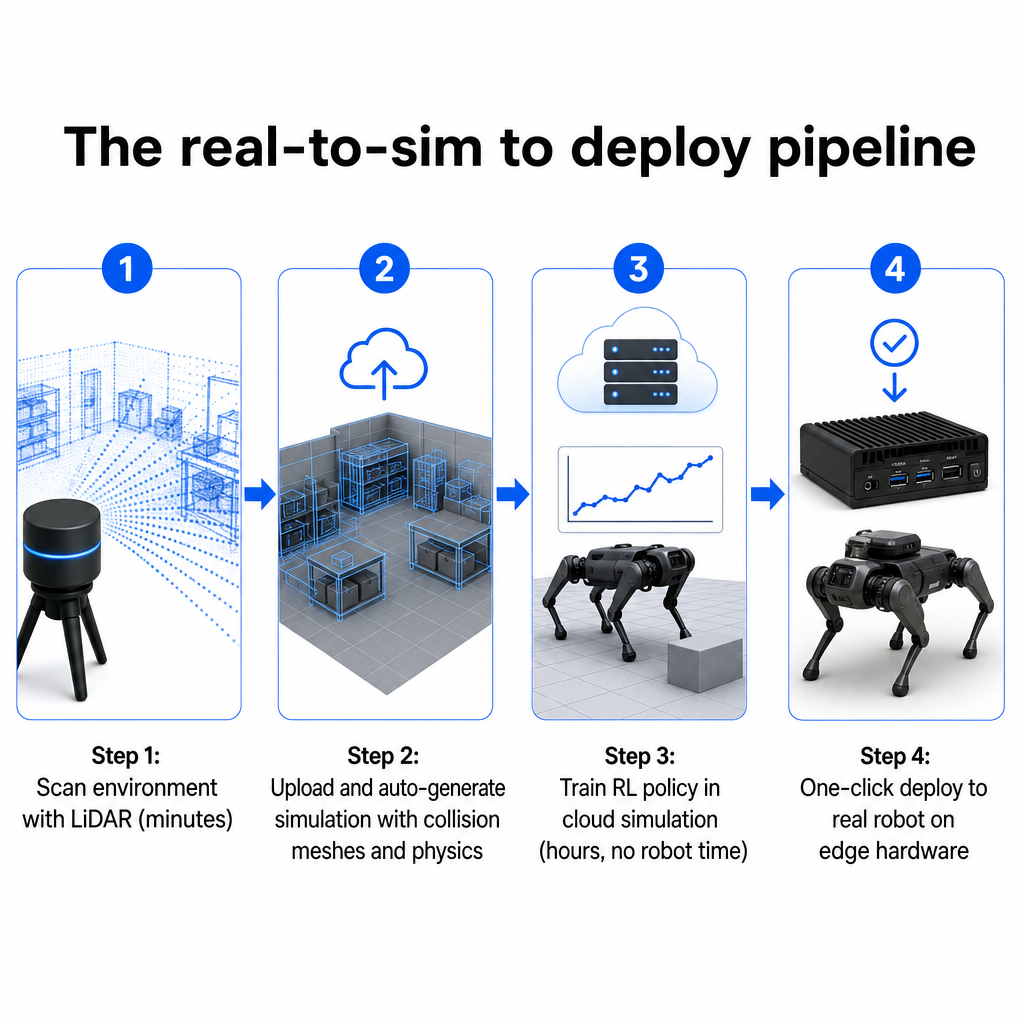
The workflow that carries a team from a physical space to a deployed skill has four stages, and each one removes a task that would otherwise demand specialist effort.
It starts with capture. Using a LiDAR scanner app or a compatible 3D mapping solution, you record the geometry, objects, and layout of the target space. OpenKinematics frames this as a job measured in minutes rather than the days it takes to hand-author a simulation scene. This is the step the platform's real-to-sim workflow is built around, and for teams used to manually modeling every shelf, bin, and fixture, it is usually the first moment the value becomes obvious.
The scan is then uploaded and processed. The platform converts it into a simulation-ready scene, generating collision meshes and physics properties automatically. Manual scene authoring — historically one of the most tedious and error-prone parts of setting up RL — disappears from the customer's workload. The reason this matters technically is well established in the literature: policy transfer depends heavily on how closely the simulated observation and action spaces match reality, so the fidelity of the captured environment directly affects how reliably a trained skill will behave on the real robot.
Training happens next, in cloud simulation. Inside that real-world-accurate scene, the platform's AI agent generates and refines control code and runs reinforcement learning, iterating on policies in hours using cloud compute. Crucially, this does not consume robot time. On-robot experimentation is slow, risky, and expensive; RL research on sim-to-real transfer and policy adaptation repeatedly points to accurate simulation as the way to compress those cycles. Doing the iteration in the cloud, against a scan of your actual space, is what lets the platform promise fast turnaround without tying up hardware.
Finally, deployment. Once a policy performs in simulation, one click pushes it to the real robot — targeting Kinematics Mini, Kinematics Max, or your own Jetson-based compute. Because the simulation was built from a scan of the real environment, OpenKinematics positions sim-to-real transfer as reliable rather than a gamble. The end-to-end path — scan, simulate, train, deploy — is the concrete shape of the "under 60 minutes" claim, with policy iteration measured in hours rather than the months of a from-scratch build.
Reusing skills instead of rebuilding them
The second lever OpenKinematics pulls is reuse. Rather than treating every task as a fresh training problem, the platform maintains a versioned hub of foundation models spanning humanoids, quadrupeds, and manipulators, plus a Robot Skills Marketplace of pretrained reinforcement learning policies for locomotion, manipulation, and task automation.
The practical effect is that teams start from a working baseline instead of a blank page. If you need warehouse locomotion for a quadruped or a manipulation primitive for an arm, you can pull an existing policy and adapt it to your environment rather than commissioning a bespoke training project. RL literature has long noted that skill libraries and multi-skill policies can cut the amount of task-specific engineering required — but it also notes that building the infrastructure to support that reuse is itself a significant undertaking. OpenKinematics packages that infrastructure as a subscription, so the reuse benefit arrives without the platform-building cost.
The marketplace also has a compounding dynamic. OpenKinematics states that every new skill trained on the platform can become available to all subscribers, framed as a model where the more the community trains, the more each subscriber gets. A single subscription is described as providing access to all public policies, which points to a subscription-based model for skill access rather than per-skill licensing. For a buyer, that shifts the economics: instead of amortizing a large upfront ML investment across a handful of internally built behaviors, you tap a growing shared library and pay for access.
Underneath the reuse story is an open foundation. The platform is powered by cap-x, described as an open-source, peer-reviewed and published robotics AI framework with research available via GitHub, and the edge runtime is OpenBrain, an MIT-licensed edge stack. That openness is part of why the "no ML expertise" promise is credible rather than a black box — the research is published so the field can inspect it, while the productized platform focuses on getting policies into production. Note the honest limit here: the marketplace is described as growing, without published figures on the number of skills, category coverage, or update cadence. Treat it as an expanding library rather than a guaranteed catalog for any specific task, and confirm coverage for your use case directly.
Choosing your edge hardware: Kinematics Mini and Max
Both of OpenKinematics' edge products run the same OpenBrain stack, so the choice between them is about deployment context, not capability tier locked behind different software.
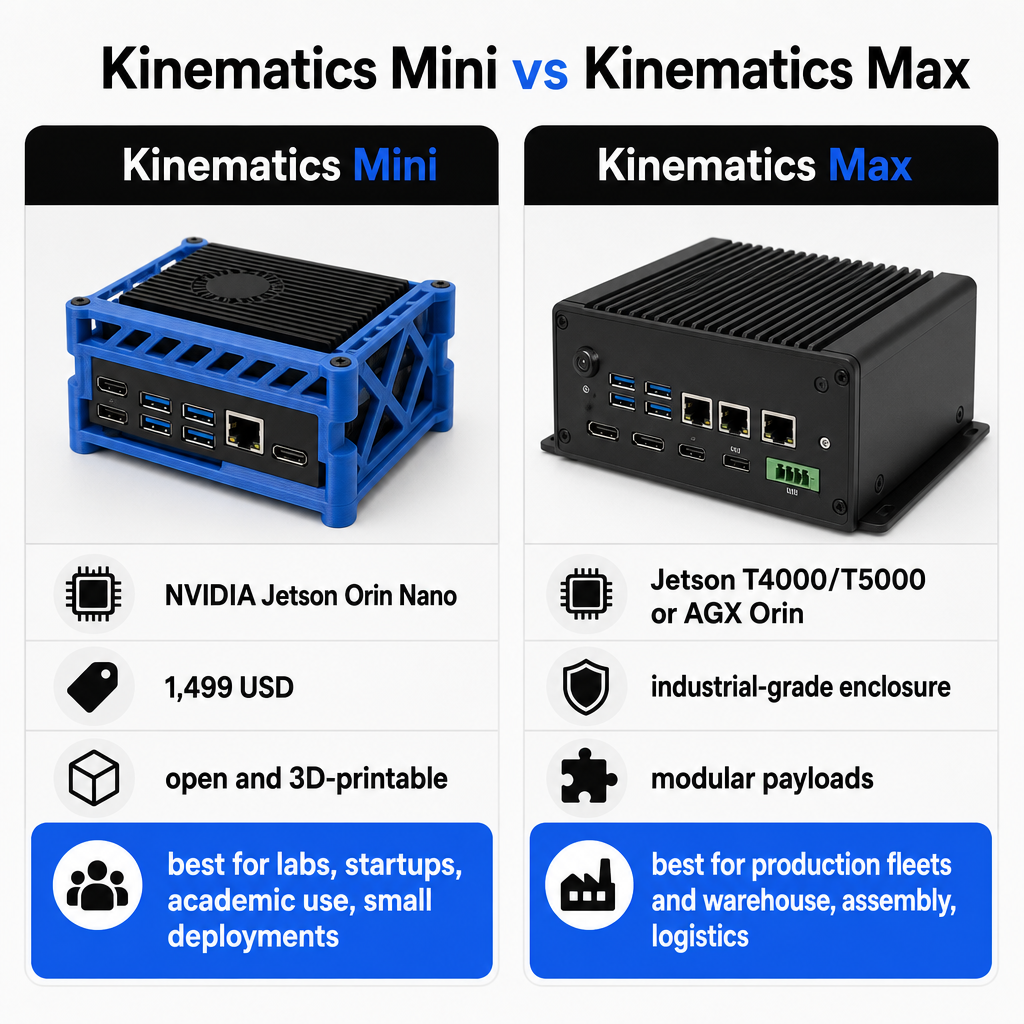
Kinematics Mini is the entry point: an open-source NVIDIA Jetson Orin Nano box priced at 1,499 USD, marketed as open and 3D-printable for makers and labs. The Jetson Orin Nano platform is a sensible foundation for this role. NVIDIA describes the Orin Nano modules as delivering up to 40 TOPS of AI performance — up to 80 times the AI performance of the previous-generation Jetson Nano — and positions them squarely at entry-level edge AI and robotics. NVIDIA's developer materials also describe the Orin Nano developer kit, with integrated storage and a reference carrier board, as built for prototyping edge AI and robotics systems. That makes Mini a credible fit for academic use, startup prototyping, and small-scale deployments where openness and cost matter.
Kinematics Max is the production form factor: an industrial-grade enclosure based on Jetson T4000/T5000 or AGX Orin, positioned for production fleets with modular payloads. The higher-end Jetson families provide substantially more on-board AI compute in a compact, power-efficient package, which is what lets meaningful reinforcement learning policies and perception stacks run at the edge rather than depending on a data center. For warehouse, assembly, and logistics operators running fleets, Max is the ruggedized, scalable option.
Because the two share a runtime, a lab can prototype a skill on Mini and move it toward production on Max without re-architecting the software. One caveat worth flagging during procurement: the exact configuration matrix for Max — which specific Jetson variants, storage, and IO options — is described only at the level of model families in public material. If your deployment has strict compute, thermal, or interface requirements, confirm the precise configuration before committing.
What no ML expertise does not mean
Removing the machine-learning burden is not the same as removing all engineering responsibility, and OpenKinematics is explicit about where the line sits. The platform's own disclaimer states that it sells edge-compute hardware and ships software — including reinforcement learning policies — that cause physical robots to move, and it acknowledges that robots can injure people, damage property, and cause irreversible harm. Its products are framed as components and tools to be integrated into a final machine by a qualified integrator, not as complete turnkey machines.
That framing carries concrete obligations. OpenKinematics states that any deployed policy must be validated by the customer in their own environment before production use, operated under human oversight with the ability to safely stop or override at any time, and monitored continuously with logging and defined failure-mode responses. This is consistent with the platform's statement that reinforcement learning policies, simulation results, and perception outputs are inherently non-deterministic and may fail — and that performance in its environments or in simulation is not a guarantee of performance in yours. Independent RL research reinforces the point: methods are sensitive to environment changes and typically require real-world adaptation and monitoring to be dependable.
So the accurate reading of "deploy robot skills without ML expertise" is specific. It removes the need to build and tune RL algorithms, simulators, and training pipelines. It does not remove the need for robotics, controls, and safety engineering. Your team still owns functional safety, standards compliance, and any regulatory approvals for your domain. That is a feature, not a gap — it puts the machine-learning complexity on the platform and keeps the safety-critical judgment with the people who understand your operation.
There are also hard boundaries on where these tools may be used. OpenKinematics' disclaimer lists uses that are prohibited or restricted without prior written authorization, including life-critical medical devices or clinical decision-making, on-road autonomous vehicles for public roads, aviation, spaceflight, and watercraft autopilots, nuclear facilities, life-support systems, and other critical infrastructure where failure could cause major harm, and autonomous weapons systems. The list also cites practices prohibited by Article 5 of the EU AI Act, such as untargeted scraping of facial images, social scoring by public authorities, certain real-time remote biometric identification, and emotion inference in workplaces or education. If your application touches any of these areas, the platform is not a self-serve fit, and you should confirm authorization and requirements directly.
Fitting OpenKinematics to your robots and your team
For a robotics startup or industrial integrator, the practical journey through the platform follows a repeatable shape. You define the skill — say, pallet pick-and-place, bin-picking, or quadruped navigation across a warehouse. You capture the environment with the LiDAR app or a compatible scanner. You upload the scan so the platform auto-generates a simulation with collision meshes and physics. You select a baseline policy from the foundation model hub or the marketplace and let the AI agent generate and refine the control code through reinforcement learning in simulation. You validate in simulation, deploy to the robot with one click, and then run staged on-robot validation with human oversight and logging before moving to production once your performance and safety criteria are met.
The integration question deserves honest framing. The platform is advertised as working across humanoids, quadrupeds, and manipulators, and as dropping into any robot platform with open-source SDKs and hardware. What the public material does not do is enumerate specific vendors, controllers, or ROS distributions — it speaks in categories rather than a compatibility list. RL and robotics research is clear that transfer depends on aligning observation and action spaces between simulation and real hardware, so the realistic model is this: OpenKinematics handles the bulk of that complexity, while your integrators adapt the final wiring, the sensor mapping, and the safety envelope to the specific machine. Whether a particular arm or mobile base is a clean fit is a question to settle directly with the team rather than infer from a category label.
The commercial picture has a similar boundary. The one firm price point in public material is Kinematics Mini at 1,499 USD. Subscription tiers for the platform and marketplace, contract lengths, enterprise terms, SLAs, and hands-on integration services are not spelled out in the surfaced pages. Treat pricing beyond the Mini as something to scope in conversation, not to estimate.
With those boundaries acknowledged, the fit is straightforward to reason about. If you are a lab or startup that wants to prototype robot skills quickly and cheaply on open hardware, Mini plus a marketplace subscription is a low-commitment way to test the pipeline against your own environment. If you are an integrator or fleet operator moving toward production, Max provides the industrial footprint while your team retains ownership of validation and safety. In both cases the strongest way to evaluate the platform is empirical: put a real environment scan and a real robot task into the pipeline and see how the trained policy behaves, rather than trying to rebuild an equivalent RL stack in-house to find out.
Frequently asked questions
Do I really not need any machine-learning staff to use OpenKinematics?
You do not need to build or tune reinforcement learning algorithms, simulators, or training pipelines — the platform's AI agent writes and iterates the Python control code and runs RL in cloud simulation for you. What you still need is robotics, controls, and safety engineering to validate policies in your environment, wire the robot correctly, and operate it responsibly. The claim removes the ML infrastructure burden, not the engineering judgment.
How long does it actually take to get a working skill?
OpenKinematics markets an end-to-end path — from environment capture to a deployable robot brain — in under 60 minutes, with policy iteration in cloud simulation measured in hours rather than months. Scanning a space is described as taking minutes, and simulation is generated automatically from that scan. Real-world timelines depend on task complexity and your validation process, but the pipeline is designed to compress the slow parts: manual scene authoring and on-robot experimentation.
Which robots and platforms are supported?
The platform advertises compatibility across humanoids, quadrupeds, and manipulators and describes itself as working with any robot platform using open-source SDKs and hardware. It does not publish a specific list of supported vendors, controllers, or ROS distributions. Integration effort can vary between platforms because policy transfer depends on aligning observation and action spaces, so confirm compatibility for your exact robot directly with the team.
What is the difference between Kinematics Mini and Kinematics Max?
Both run the same OpenBrain edge stack. Mini is an open-source, 3D-printable NVIDIA Jetson Orin Nano box at 1,499 USD, aimed at labs, startups, and academic use. Max is an industrial-grade enclosure based on Jetson T4000/T5000 or AGX Orin, built for production fleets with modular payloads. Because the runtime is shared, you can prototype on Mini and scale to Max without rearchitecting your software.
Is OpenKinematics safe to deploy in production?
The platform ships software that moves physical robots and is explicit that RL policies are non-deterministic and may fail. It requires customers to validate policies in their own environment, keep human oversight with a reliable stop or override, and monitor continuously with logging and defined failure responses. Products are positioned as components integrated by a qualified integrator, and certain high-risk uses are prohibited without written authorization. Production safety is a shared responsibility that stays partly with your team.
How does the skills marketplace pricing work?
OpenKinematics describes a single subscription that provides access to all public policies in the marketplace, which points to a subscription model rather than per-skill licensing, and it states that skills trained on the platform can become available to all subscribers. Detailed subscription tiers, contract terms, and enterprise pricing are not published in the surfaced material, so scope those specifics with the team when planning a deployment.