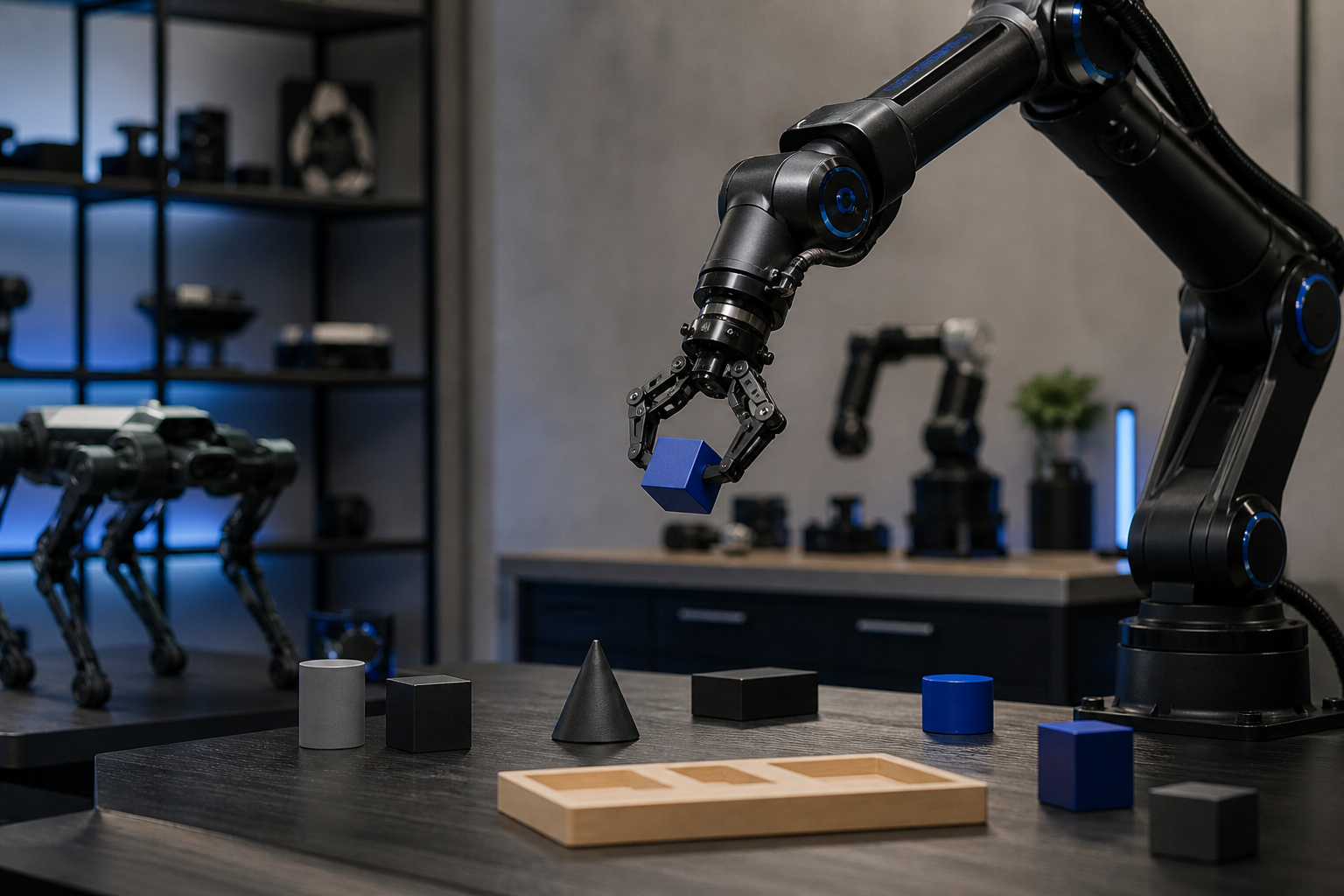
Adaptive Robotics: How Robots Are Learning to Handle the Unexpected
Why Static Robot Skills Break the Moment They Leave the Lab
A warehouse manipulator drops onto a stack of mixed-SKU cartons under fluorescent light cut by skylight glare. The third box from the left has a slick laminated surface, a payload offset 4 cm from its geometric center, and a tilt the policy never saw in sim. The gripper closes. The box rotates. The robot commits to the place motion anyway, and the carton tumbles onto the conveyor. Two aisles away, a quadruped flags an IMU anomaly on a wet metal grate and stalls mid-stride. Your options narrow fast: roll back the deployment, or escalate to ML for a three-month retraining cycle.
This is the moment adaptive robotics is built for. The discipline is not a feature add to your existing skill stack — it is the engineering choice to design policies that expect the world to drift and update against that drift at runtime, before failure compounds. The question is not whether your robot will leave its training distribution. It will. The question is how the policy responds when it does — and whether that response can ship without rebuilding the stack from scratch.
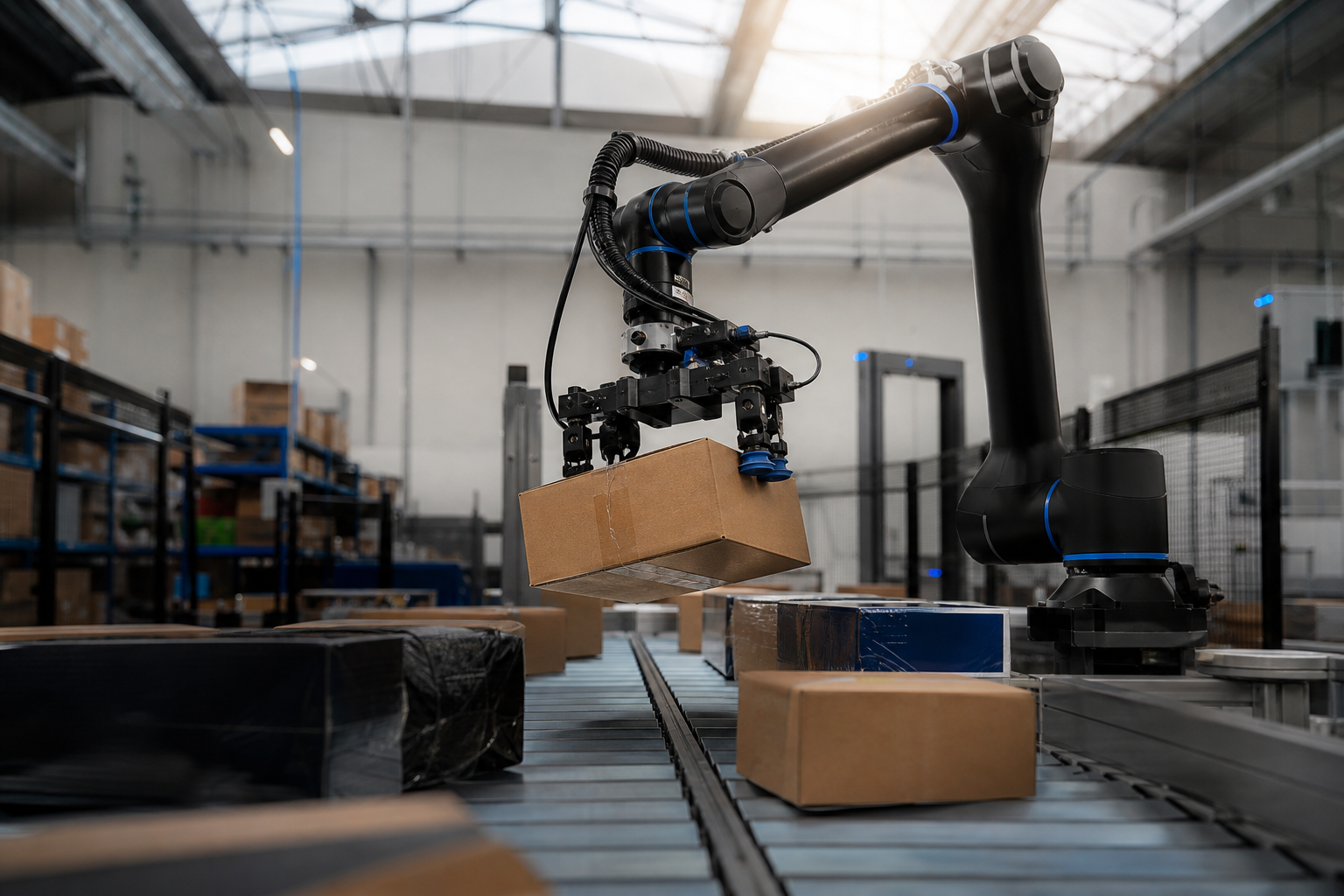
Table of Contents
- Why Static Robot Skills Break the Moment They Leave the Lab
- Static Reinforcement Learning vs. Adaptive Policies — What Actually Changes
- The Four Technical Foundations That Make a Robot Adaptive
- Where Adaptation Fails — Failure Modes and Detection Signals
- Building Adaptive Skills Without an In-House ML Team
- How Adaptation Differs Across Manipulators, Quadrupeds, and Humanoids
- Standing Up Your First Adaptive Deployment — An Action Checklist
- FAQ — Three Questions Operators Actually Ask
Why Static Robot Skills Break the Moment They Leave the Lab
The mechanism of failure is not exotic. Sim-trained policies overfit to the friction coefficients, lighting spectra, sensor noise profiles, and payload distributions they saw during training. When any of those variables drift in production, the policy's confidence collapses — but its actions don't. It still commits, just to the wrong action. That is the operational signature of a static skill encountering real-world deployment: full-throttle confidence on the wrong trajectory.
Consider the variables individually. A cardboard box at 22°C and 40% humidity has measurably different surface friction than the same box at 30°C and 70% humidity. A trained policy that converged on a friction coefficient of μ=0.6 can fail at μ=0.4 because the grip force required to prevent slippage no longer matches the policy's learned action distribution. Lighting drifts similarly: warehouse LEDs at 4000K shift to afternoon skylight at 5800K, and the RGB input distribution shifts enough to degrade vision-policy confidence without producing an explicit error. Payload distribution is the third silent killer — a 2 kg package with a center-of-mass offset 4 cm from its geometric center generates torque the gripper controller never modeled. None of these failure modes throw exceptions. They throw bad actions.
Imperial College London's Adaptive & Intelligent Robotics group frames the gap explicitly. According to Imperial College London, current robots are effective in "controlled, known environments" but require adaptation to handle "unknown environments or damage" — and that adaptation has to happen after deployment, not just during training. The lab's stated objective is to "improve the algorithmic foundations of learning algorithms to increase the versatility, resilience and autonomy of physical robots." Resilience, in this framing, is not a property of the controller at training time. It is a property of the controller while it is running.
The empirical comparison is sharper. According to research published in Science Robotics, conventional optimal and adaptive control baselines were only about half as effective at recovering from unmodeled disturbances as an online learning controller that updated its internal dynamics model every 225 ms. The same study found that a naive online deep reinforcement learning baseline was "entirely ineffective" at real-time perturbation recovery. Static controllers, classical adaptive control, and bolted-on online RL all underperform the same benchmark: a controller that treats the real world as a stream of fresh data to update against.
The operator cost narrative follows directly. Teams face two unattractive paths if they do not invest in adaptation. The first is overtraining with massive domain randomization — engineering months, expensive sim compute, and a policy that is conservative everywhere and excellent nowhere. The second is accepting brittleness and paying it back in rollbacks, downtime, and on-site engineer visits. Both paths leak money. Neither addresses the underlying issue that the world will continue to drift after the policy ships.
The industrial context makes the urgency concrete. According to the International Federation of Robotics World Robotics yearbooks, global industrial robot installations now exceed 500,000 units per year, concentrated in logistics, warehousing, and general industry — exactly the environments with the highest variation in object mix, lighting, and human presence. Static skills do not scale into those environments. The math of fleet operations does not tolerate per-site retraining cycles measured in months.
Adaptive robotics, then, is not a marketing category. It is the engineering discipline of building skills whose runtime assumption is that the training distribution will be wrong. The skill expects drift. It instruments for it. It responds inside the control loop, not inside the next retraining sprint.
A robot trained on ten thousand identical grasps can fail on the ten-thousand-and-first because friction shifted by 0.2 coefficient points. Adaptation isn't optional — it's the gap between prototype and production.
Static Reinforcement Learning vs. Adaptive Policies — What Actually Changes
Static reinforcement learning policies treat the world as a fixed distribution sampled once at training time. The weights freeze. The deployment runs inference. If the world drifts, the policy does not know — it just produces lower-quality actions with the same confidence as before. Adaptive policies treat the world as a stream of evidence to update against. Inputs are not just used to select actions; they are used to update the model that selects actions. The difference shows up in eight operational dimensions, and every one of them changes how you design, deploy, and monitor the skill.
| Dimension | Static RL Policy | Adaptive RL Policy |
|---|---|---|
| Training regime | Offline, single environment distribution | Offline pretraining + online update from deployment data |
| Sensor input handling | Fixed feature set, fixed weights | Dynamic feature weighting via prediction error |
| Response to novelty | Fail-over or fixed fallback action | Real-time policy adjustment via local model update |
| Update signal | Episodic reward, sparse | Model prediction error at every timestep |
| Update frequency at runtime | Zero (frozen weights post-deploy) | ~225 ms inner loop on embedded hardware |
| Recovery from disturbance | Roughly half as effective as online learning | ~2× more effective than classical adaptive control |
| Retraining trigger | Manual, engineer-driven | Automated thresholds or continuous online update |
| Compute requirement | Standard inference stack | Edge inference + local learning loop |
The 225 ms figure is not aspirational. It is the demonstrated update interval from the "Fast Learning-based Adaptation" controller documented in Science Robotics, running entirely on embedded hardware with no cloud offload. That works out to a 4–5 Hz inner adaptation loop — slow enough to be computationally feasible on commodity edge boards, fast enough to recover from perturbations like partial damage, flat tires, and wind gusts before the high-level controller commits to a failed trajectory.
The deeper architectural shift is the update signal itself. Standard deep RL adapts based on reward — sparse, episode-level, often delayed by seconds or minutes. Adaptive policies built on model-based meta-reinforcement learning use model prediction error at every timestep instead. According to BAIR's research on model-based meta-RL, this dense signal enables millisecond-scale parameter updates without waiting for an episode to complete. The robot compares what its dynamics model predicted the next sensor reading would be against what the sensor actually returned, then updates the model based on the gap. Prediction error is everywhere. Reward is somewhere.
The counter-evidence matters here. Adaptation is not "throw RL at it online." The Science Robotics study found that naive online deep RL was entirely ineffective at recovering from real-time perturbations in their tested scenarios. Bolting an online policy gradient onto a static controller and hoping for adaptation produces a system that drifts further from competence with each update. The functional adaptive systems in the literature share specific traits: a model-based update target, a prediction-error signal, and a local learning loop short enough to fire inside the control budget. Teams that conflate "online learning" with "online deep RL" tend to discover the difference the expensive way.
The operational implication is that adaptation happens in situ, on the edge, not in the cloud. A 225 ms update budget does not survive a cloud round-trip. The runtime substrate for adaptive policies is local inference hardware with enough headroom to run both the control policy and the model update math in the same loop. That is a hardware specification before it is an algorithm choice.

The Four Technical Foundations That Make a Robot Adaptive
Adaptation is not a single algorithm. It is a stack of four interlocking capabilities: dense sensory feedback loops, hierarchical policy decomposition, meta-learning for few-shot specialization, and edge-native inference with a local learning loop. Each one underperforms in isolation. Miss any one and the others cannot compensate.
1. Dense Sensory Feedback Loops
Adaptive robots ingest proprioception (joint encoders, force/torque, IMU) and exteroception (LiDAR, RGB-D, contact sensors) at the control loop rate — typically 100 to 1000 Hz for low-level control. The signal that drives adaptation is prediction error: the gap between what the policy expected the sensor to read and what it actually read. According to BAIR, model-based meta-RL uses this prediction-error signal at every timestep instead of waiting for episode-level rewards. Concrete example: a quadruped adjusts step height mid-gait because its IMU registered an unexpected pitch acceleration 8 ms ago. The policy did not wait for a fall to learn. It updated against the discrepancy as soon as the sensor produced it.
2. Hierarchical Policy Decomposition
Adaptive systems separate high-level task intent ("place box on pallet position 3") from low-level motor adaptation ("modulate gripper force to keep slip rate below 2%"). The high-level policy stays stable. The low-level adapts. According to industry vendor Robotnik, this pattern shows up as "hierarchical intelligence" — layered, independent modules for perception, trajectory planning, recognition, and position calculation. Why it matters operationally: one reusable skill, many execution paths. You do not retrain the strategy when only the tactics need to change, and you do not let tactical adaptation destabilize strategic decisions.
3. Meta-Learning for Few-Shot Adaptation
The robot learns how to adapt during training, not just what to do. Model-agnostic meta-learning (MAML) and model-based meta-RL pre-train a prior such that a few new data points are sufficient to specialize the policy. BAIR's legged-robot demonstration adapts to a partially disabled leg in "just a few timesteps" — milliseconds, not episodes. The alternative — retraining from scratch on each new variation — costs weeks of engineering and sim compute. Meta-learning trades training-time compute for deployment-time agility. The policy ships with the prior baked in; specialization happens after first contact with the real environment.
4. Edge-Native Inference with a Local Learning Loop
The 225 ms onboard update interval documented in Science Robotics runs entirely on embedded hardware. This is infrastructure, not algorithm: if your inference stack cannot accommodate gradient updates, sparse model retraining, or Kalman-style state correction in-loop, no amount of policy cleverness recovers. As industry vendor Robotnik notes, adaptive robotics has been driven by parallel advances in AI, computer vision, IoT, and electronics. Without rich sensing and sufficient edge compute, continuous adaptation is not feasible. The board that runs the policy has to run the update too, or the update never fires inside the budget.
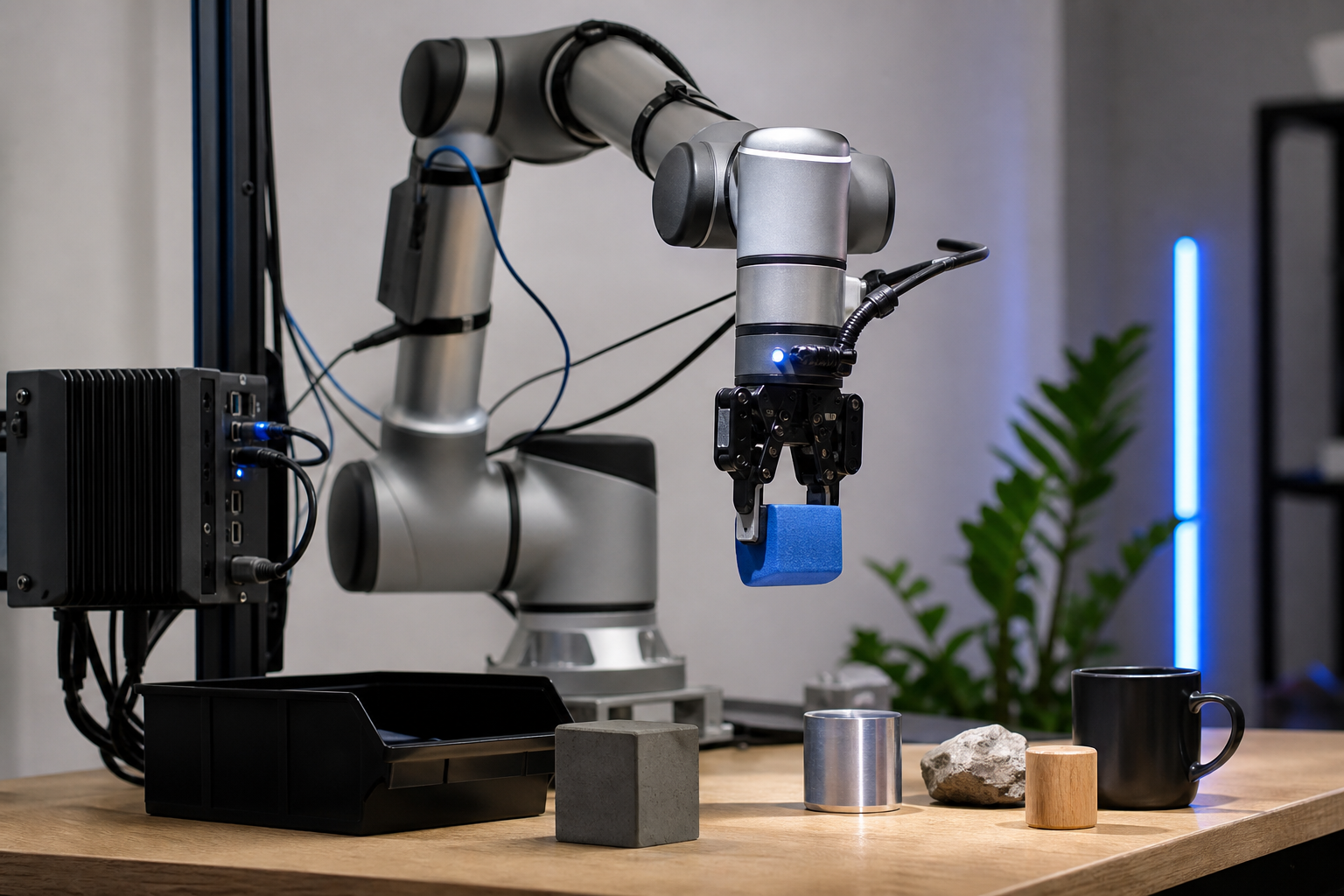
Adaptation happens in milliseconds at the edge, not weeks in the cloud. Local inference is not a deployment preference — it is the algorithm's runtime substrate.
Where Adaptation Fails — Failure Modes and Detection Signals
Adaptation is not a guarantee. It is a capability with failure modes, and the teams that ship reliable adaptive systems are the ones who instrument for failure detection before fleet rollout. Five failure modes appear repeatedly across humanoids, manipulators, and mobile platforms. Each one has a detection signal that fires before task success rate craters. Each one has a mitigation that costs less than discovering the failure in production.
| Failure Mode | Detection Signal | Mitigation | Highest-Risk Context |
|---|---|---|---|
| Distribution shift beyond training bounds | Confidence drop; repeated fallback events | Pre-deployment domain randomization audit | Warehouse SKU mix with high variance |
| Sensor degradation (dust, occlusion) | Anomaly flags; unexplained F/T spikes | Redundant sensor fusion; inspection intervals | Outdoor, high-dust, or wet environments |
| Conflicting adaptation objectives | Oscillating behavior; safety triggers | Explicit multi-objective weighting; ISO limits | Humanoids near humans; safety-critical tasks |
| Insufficient edge compute | Latency creep; missed 225 ms budget | Profile model size vs. board before rollout | Older Jetson boards; undersized stacks |
| Naive online deep RL as adaptation method | Persistent degradation post-perturbation | Replace with model-based or meta-learned approach | Real-time recovery scenarios |
The last row deserves the most attention because it is the most common architectural mistake. According to Science Robotics, naive online deep RL was entirely ineffective at real-time perturbation recovery in the tested scenarios. Teams that bolt online policy-gradient updates onto a static policy without changing the underlying update signal will pay for it in production — the system does not adapt, it drifts. The fix is structural: switch the update target to a model with prediction-error signal, or use a meta-learned prior with few-shot fine-tuning. The fix is not "tune the learning rate."
The safety-critical row is anchored to standards, not preference. ISO 10218-1/2 governs industrial robots and robot systems; ISO 13482 governs personal care robots. Both define protective stops and speed/force limits that any adaptive controller must respect, even when modifying motion profiles at runtime. Adaptive does not mean unbounded. An adaptive gripper force controller that occasionally exceeds its certified envelope under novel payload conditions is not adaptive — it is non-compliant. Multi-objective reward weighting and hard-coded safety envelopes are how you keep adaptation inside the certification boundary.
The compute row is the one most teams underestimate. The 225 ms budget is demonstrated, not assumed — and it is demonstrated on hardware specifically profiled to handle the model update math in-loop. Before you commit to an adaptive policy architecture, profile the model size against the target board. A policy that updates in 225 ms on a desktop GPU may take 800 ms on the deployed edge board, which means the update fires after the next control decision has already been made. The system looks adaptive on paper and behaves statically in practice.
The operator takeaway: detection signals are leading indicators. By the time task success rate drops, you have already shipped failures to the field. Confidence score telemetry and prediction-error logging are the early-warning system. Build them before the rollout, not after the first incident report.
Building Adaptive Skills Without an In-House ML Team
The assumption that adaptive robotics requires ML PhDs comes from the era when teams trained policies from scratch. That era is over. The practical workflow now is composition, not invention. The technical lift is specifying constraints and instrumenting telemetry — not deriving novel loss functions.
Start From Pretrained Policies, Not Scratch
Open-source and commercially available policies for grasping, locomotion, and object pushing already embed core adaptation patterns: domain randomization, recurrent state, prediction-error update signals. Fine-tuning a pretrained policy on your specific variation envelope takes deployments measured in dozens, not the thousands required for training from zero. The technical effort shifts from "train a policy" to "specify the variation envelope you need it to handle." That specification is a product decision, not a research decision. Any robotics engineer with a clear understanding of the deployment environment can write it.
Seed Adaptation Data with Real-to-Sim Capture
Hand-tuning simulation parameters to match your facility is a months-long calibration exercise that produces a sim approximating your environment. Scanning the deployment environment with LiDAR and converting to a sim-ready mesh inverts the problem: the sim is now anchored to ground truth, and domain randomization perturbs from there. The more realistic your sim variation, the better your adaptive policy generalizes when it hits the real environment. Real-to-sim pipelines are how teams without dedicated sim engineers produce training environments good enough to support adaptive fine-tuning. The capture step is hours, not months.
Run Staged Rollouts with Telemetry-Driven Gates
Never flip a switch on a fleet. The staged pattern is: one robot, then five robots, then fleet — with each stage gated on telemetry. Confidence score distribution, fallback frequency, task success rate, prediction-error magnitude. According to industry vendor Robotnik, adaptive systems are those that "modify their behavior in response to contextual changes," which implies you need to measure those contextual changes to verify the adaptation is working. Without instrumentation, "adaptive" is unverifiable marketing. With instrumentation, you catch a stage-two variance before it becomes a stage-three outage.
Define Adaptation Boundaries Explicitly
Decide what the robot is allowed to adapt before deployment. Gripper force tolerance? Approach velocity? Step height? Object classification confidence threshold? Constraining the adaptable parameter set prevents the policy from drifting into unsafe or out-of-spec behavior. ISO 10218 and ISO 13482 set hard floors here — adaptive force and velocity changes must stay inside the certified envelope. Adaptation boundaries are also debugging tools: when something goes wrong, you have a finite parameter space to inspect rather than an unconstrained policy that could have changed anything.
Automate Retraining Triggers Instead of Manual Schedules
Set quantitative thresholds. If the rolling 7-day fallback rate exceeds 15%, queue a retraining job. If prediction-error magnitude exceeds the training-distribution 95th percentile for more than 200 consecutive timesteps, flag for review. Automate the trigger; the human decides only on the retraining content, not the timing. According to industry vendor Micropsi Industries via Automatica News, founder Ronny Vuine argues that smaller companies need automation that can "quickly adapt to new situations" — and that this requires treating automation primarily as software that can be changed quickly. The corollary: change should be triggered by data, not by calendar.
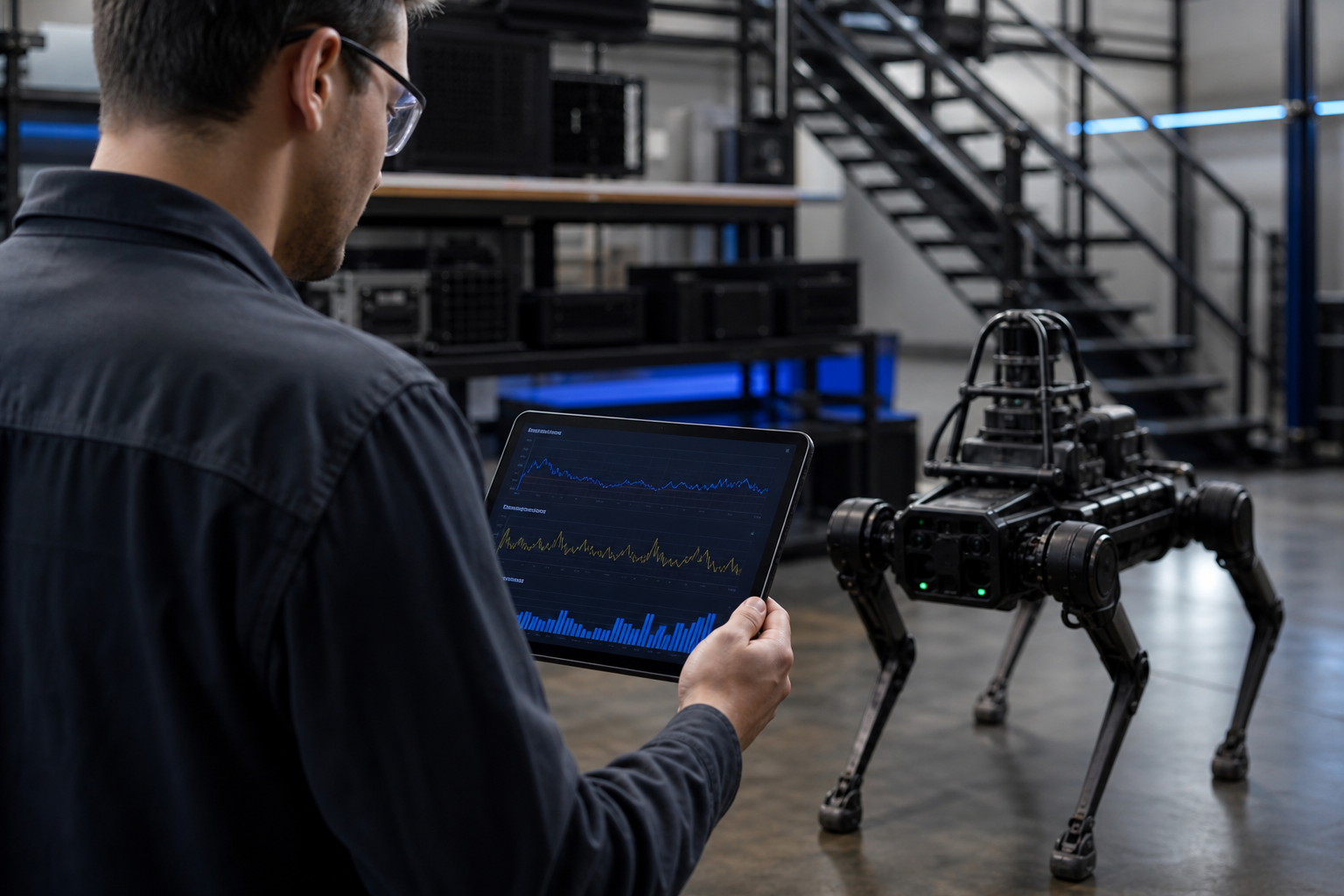
You don't need an ML team to build adaptive robots. You need a clear adaptation boundary, a telemetry plan, and a trigger that fires without waiting for a human to notice.
How Adaptation Differs Across Manipulators, Quadrupeds, and Humanoids
Adaptation looks operationally different depending on the robot's morphology. Degrees of freedom, dynamics complexity, and the dimensionality of the error surface all determine how long convergence takes and what to instrument. The platform you pick for your first adaptive deployment will determine whether the project ships in a quarter or stalls for a year. Pick by this table.
| Platform | Primary Adaptation Challenge | Driving Sensors | Typical Iterations to Convergence | Deployment Complexity |
|---|---|---|---|---|
| Manipulators (fixed-base arms) | Gripper friction, payload variance, pose drift | Force/torque, gripper state, RGB-D | 10–50 deployments | Moderate |
| Quadrupeds | Terrain variation, contact dynamics, CoM shift | IMU, joint proprioception, contact sensors | 20–100 deployments | High |
| Humanoids | Bipedal stability + manipulation under variable contact | Full-body IMU, force plates, vision | 50–200 deployments | Very high |
| Mobile manipulators | Coupled locomotion + arm precision | LiDAR, odometry, arm F/T, vision | 30–150 deployments | Very high |
The deployment iteration ranges are practitioner-typical planning heuristics, not benchmarked statistics. They reflect the practical convergence behavior teams report when porting adaptive policies across morphologies. Treat them as scoping inputs for your first project, not as guarantees.
The error surface dimensionality argument explains the spread. A fixed-base manipulator with 7 degrees of freedom and a single gripper has a state space orders of magnitude smaller than a humanoid with 25+ degrees of freedom and bipedal dynamics. Adaptation has to search this space; higher dimensionality means longer convergence. The math is unforgiving — a humanoid's adaptation problem is not "a little harder" than a manipulator's. It is structurally harder.
The contrast between quadrupeds and humanoids is the most instructive case. Both are legged. Both have contact-dominated dynamics. Quadrupeds adapt faster because of static stability margins. A quadruped can maintain support polygon stability with one leg compromised — BAIR's model-based meta-RL demonstration shows real-world adaptation to a disabled leg in a few timesteps. Humanoids have a zero-margin stability problem. Every adaptation step risks a fall. That is why humanoid adaptation needs higher-fidelity sensing, more conservative update rates, and far more iterations to validate.
Manipulators are the right starting point for most teams. Lowest convergence iteration count. Clearest failure signals — force/torque spikes are unambiguous in a way that "the robot looks slightly less stable" is not. Fixed-base means the safety envelope is geometrically bounded. According to industry vendor Micropsi Industries via Automatica News, industrial deployment of adaptive controllers focuses on manipulation tasks like cable insertion and bin-picking precisely because precision-under-variation is where the ROI is clearest and the validation path is shortest.
The strategic takeaway: do not validate your adaptation workflow on humanoids first. Prove it on a manipulator. Port the telemetry architecture and retraining trigger logic to higher-complexity platforms once the operational pattern is working. The same retraining-trigger logic works across morphologies. The convergence times do not.
Standing Up Your First Adaptive Deployment — An Action Checklist
This is the sequence. Skip steps and you ship brittle deployments. Each step has a decision gate — do not advance until the gate is satisfied. The total elapsed time from step 1 to step 6 typically runs four to eight weeks on a manipulator; longer on legged platforms.
1. Audit your current skill's adaptability baseline.
Identify which components of the current policy are static (frozen weights, hardcoded thresholds, fixed feature selectors) and which are already adaptive (dynamic thresholds, sensor-driven feedback, recurrent state). The audit determines retooling scope. Most legacy skills are 90% static even when the team thinks they are "smart." Gate: documented inventory of static vs. adaptive components, signed off by the engineer who will own the deployment.
2. Pick exactly one source of real-world variation to address.
Gripper friction. Lighting. Object weight. Terrain. Object pose. Pick one. Adapting to everything at once produces unverifiable systems whose failure modes cannot be isolated. Bound the problem to one parameter dimension for the first deployment. Gate: a single-sentence variation spec — for example, "policy must handle gripper friction coefficient μ in [0.3, 0.8] across box surfaces."
3. Collect baseline failure data with the existing static policy.
Run the current non-adaptive policy in the target environment. Log every failure, fallback, and edge case for two weeks minimum. This is the ground-truth dataset that defines what adaptation must solve and what success looks like. Without baseline failure data, you have no way to measure whether adaptation improved anything. Gate: minimum 200 logged events spanning the chosen variation dimension, stored in a queryable format.
4. Select or fine-tune an adaptive policy using domain-randomized sim.
Use a pretrained policy as the starting point. Seed the sim from real-to-sim capture of your deployment environment so the randomization perturbs from a realistic anchor. Train with domain randomization across the variation envelope from step 2. Validate convergence in sim before any real-hardware deployment. Gate: sim performance meeting target success rate (typically 95% or higher) across the randomized envelope, including the edge cases.
5. Instrument the deployment for adaptation telemetry.
Log per-timestep: policy confidence, prediction error, sensor anomaly flags, fallback events, task success, and inference latency. Without telemetry you have no signal that adaptation is working — only that the robot is moving. The 225 ms onboard update budget documented in Science Robotics is the latency benchmark; if your inference cycle is running longer than that, the update fires too late to matter. Gate: telemetry pipeline writing to persistent storage with a queryable schema and dashboards for the four core signals.
6. Run a staged rollout: 1 robot → 5 robots → fleet.
Each stage runs a minimum of 72 hours of continuous operation. Compare telemetry distributions stage-over-stage — the 5-robot mean confidence should match the 1-robot distribution within a defined tolerance, or you have found a variation the policy missed. Resist the pressure to skip the 5-robot stage. That is the stage where site-specific drift surfaces before it becomes a fleet-wide outage. Gate: stage-over-stage telemetry parity within tolerance before advancing.
7. Define and automate retraining triggers.
Set quantitative thresholds. Rolling 7-day fallback rate exceeds 15%, trigger a retraining job. Prediction-error 95th percentile exceeds training-distribution bounds, trigger a review. Confidence score median drops more than two standard deviations below baseline, trigger an investigation. Human judgment decides retraining content; data decides retraining timing. Gate: documented thresholds wired into the deployment monitoring system with paging or ticket-generation hooks.
8. Archive every deployment's telemetry for the next training cycle.
Deployment data is the training set for the next policy iteration. Real failures are higher-value than synthetic ones — they are sampled from the true distribution rather than a randomization envelope. Store raw sensor streams, policy decisions, and outcomes in a structured format that can be replayed through future policies. Gate: archival schema validated by replaying a stored episode through the current policy and confirming reproduction of the original outcome.

FAQ — Three Questions Operators Actually Ask
How long does it take a robot to adapt in the real world?
It depends on morphology and on what you mean by "adapt." Two different timescales are in play. At the runtime control loop, adaptation is fast: BAIR's model-based meta-RL legged robot adapts to a damaged leg in a few timesteps — milliseconds. The Science Robotics online learning controller updates its model every 225 ms. These are real-time adaptation events — episodic adjustments inside a single execution. Policy convergence to a stable, broadly competent adapted behavior is a different question, and it runs from roughly 10 deployments on a fixed-base manipulator to 200 on a humanoid. Clarify which one you need to plan for before you set expectations with stakeholders.
Can I use one adaptive policy across multiple environments, or one per location?
One policy can generalize across environments if trained with sufficient domain randomization spanning the variation envelope of all target sites. Performance typically degrades at the envelope edges — sites whose conditions sit near the boundary of the training distribution underperform sites near the center. The trade-off is operational: a broader randomization envelope costs more sim compute and may underperform a site-tuned policy on any individual site. The practical pattern most teams converge on is to train a generalist policy, deploy it everywhere, and fine-tune per site only when telemetry shows site-specific underperformance against the fleet average. That keeps the fleet on one base policy with surgical specialization where data justifies it.
What's the difference between adaptation and re-planning?
Adaptation adjusts how a skill executes — gripper force, step height, approach velocity, contact strategy — within a fixed task definition. Re-planning changes what the robot is doing: choosing a different grasp pose, rerouting around an obstacle, switching to an alternate task. Adaptive policies handle the former at the control loop rate. They are not a substitute for higher-level task planning, motion planning, or behavior trees. According to industry vendor Robotnik, the "hierarchical intelligence" framing captures this distinction cleanly — adaptation is the bottom layer of the stack, planning is the top. Conflating them produces architectures where the policy tries to plan and the planner tries to adapt, and neither does either well.