Simulation Swarm: How Cloud-Scale Robot Training Accelerates Skill Deployment
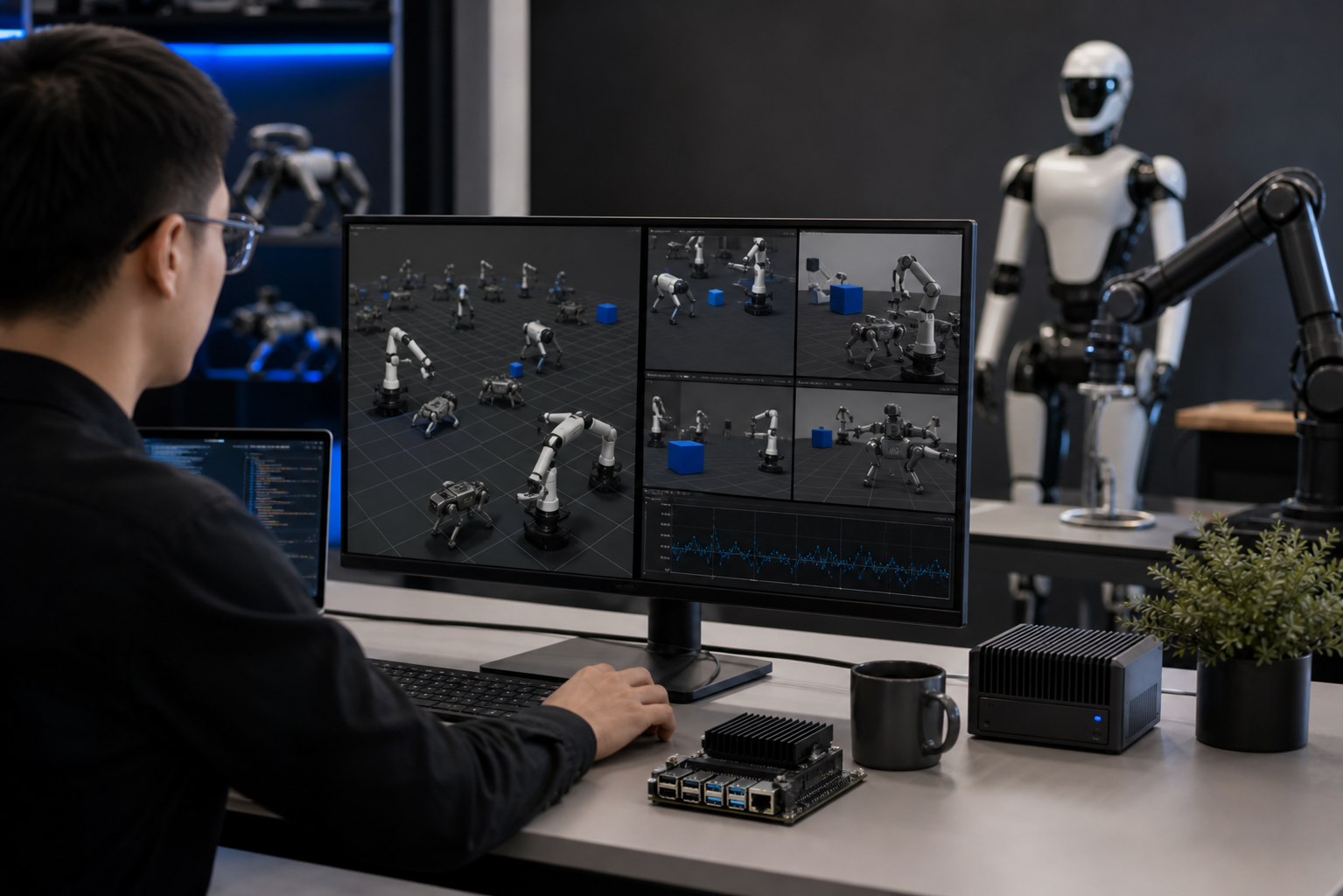
You have a robot on the bench, a task defined, and a deadline that already assumes the policy works. But training that policy on physical hardware means running one trial at a time — resetting the arm, re-racking objects, babysitting a quadruped that might faceplant and take $10K of actuators down with it. Weeks of wall-clock time drain into supervision and hardware wear before you ever ship a skill. The dividing line between teams deploying robot skills in an afternoon and teams stuck in a six-month training loop is not smarter engineers. It is how many attempts they can run at once. That is what a simulation swarm delivers: thousands of virtual robot instances training simultaneously in the cloud, compressing months of physical trial-and-error into minutes. The scale is not hypothetical. GPU-accelerated simulation has demonstrated training speedups of 2–3 orders of magnitude over CPU-based simulators on continuous-control tasks, turning weeks of policy optimization into hours, according to SyncedReview. This article breaks down how swarm-scale simulation works mechanically, when it beats physical training, what infrastructure makes it possible, how to close the sim-to-real gap, and how your team should decide whether to build it or subscribe to it.
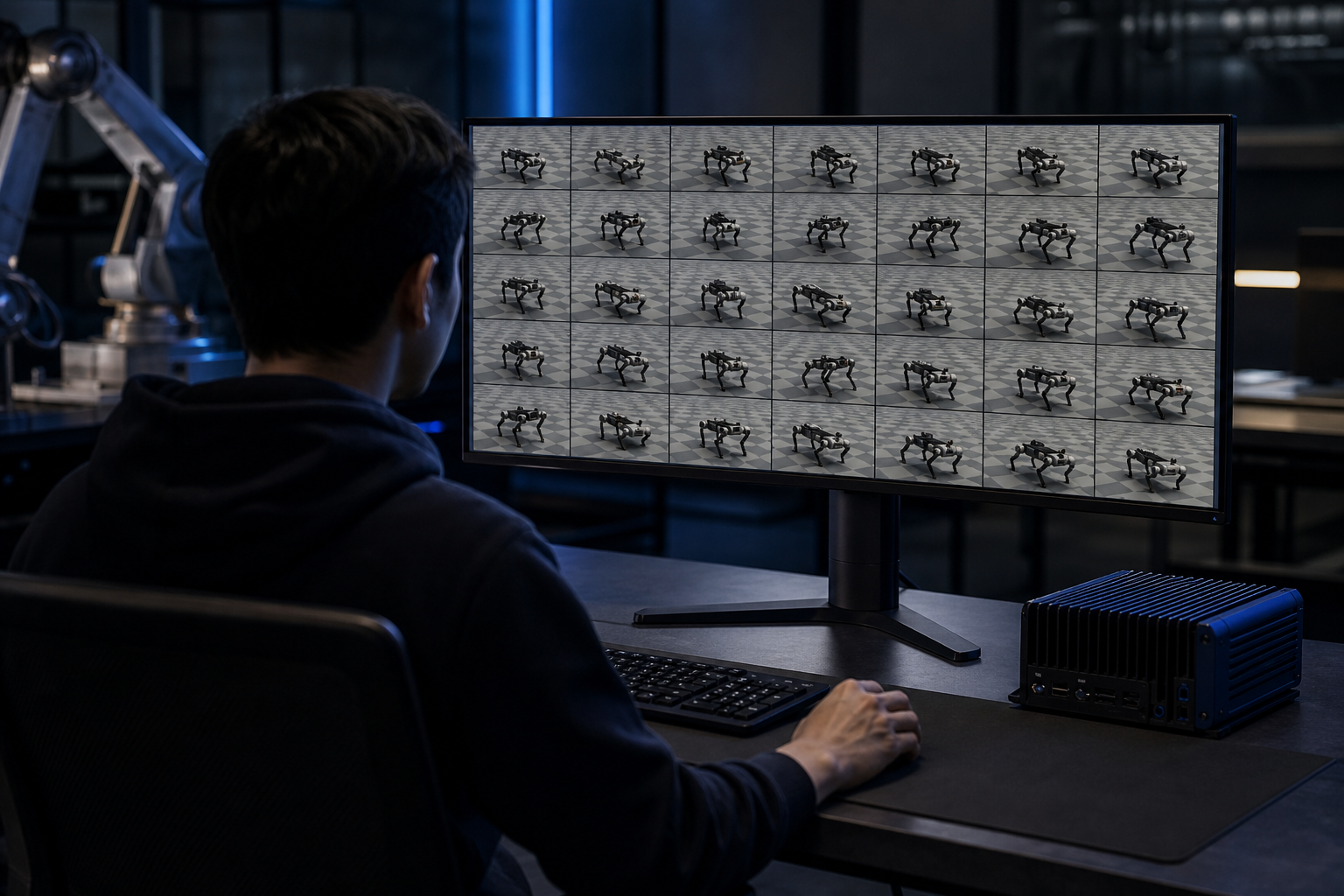
Table of Contents
- Why Single-Robot Training Hits a Wall
- What a Simulation Swarm Actually Is
- How Real-to-Sim Capture Feeds the Swarm
- Swarm Training vs. Real-World Training: When Each Wins
- The Infrastructure Behind Swarm-Scale Training
- From Swarm to Robot: Closing the Sim-to-Real Gap
- Evaluating a Simulation Swarm Approach: A Team Decision Guide
- Simulation Swarm FAQ
Why Single-Robot Training Hits a Wall
Sequential physical training is throttled by four hard limits: wall-clock time, hardware wear, safety supervision, and non-reproducible conditions. Each one compounds the others, and together they define the ceiling the swarm exists to break.
Start with the sample problem, because it dwarfs everything else. Deep reinforcement learning for robotics routinely consumes millions of environment interaction steps to converge a policy — a volume that is slow and expensive to gather physically, whereas simulation can in principle supply near-infinite experience. As OpenAI research scientist Lilian Weng frames it, deep RL's sample inefficiency combined with the high cost of real-robot data collection is precisely why simulators are essential — they can, in principle, provide an infinite amount of data. A manipulation policy that needs millions of contact-rich interaction steps is simply infeasible on a single arm running in real time. One trajectory per attempt, plus reset time, plus re-racking the objects. The arithmetic never closes.
Then make it physical. For a quadruped learning locomotion, every failed gait experiment is a fall, and a fall risks actuator and chassis damage on hardware that can run $10K or more. There is no "undo" on a physical trial the way there is in a simulator. A bad exploration step in software costs you nothing but a reset flag. The same step on hardware can cost you a week of RMA turnaround and a shipping label. Multiply that across the thousands of exploratory failures RL demands during early training, and physical iteration stops being a training strategy and becomes a hardware liability.
A robot skill isn't limited by how smart your algorithm is — it's limited by how many times your robot can afford to fail.
Non-reproducibility is the quieter killer. Physical conditions drift constantly: lighting shifts through the day, floor surfaces wear, gripper pads glaze, sensor calibration wanders. Two "identical" trials are never truly identical, which corrupts the clean signal RL needs to attribute reward to action. In simulation, every variable is logged and controllable — friction coefficient, object mass, sensor latency, actuator gain. You can replay a failure exactly, isolate the cause, and re-run it a thousand times with one parameter changed. That level of experimental control is impossible on a bench where the ambient conditions rewrite themselves every hour.
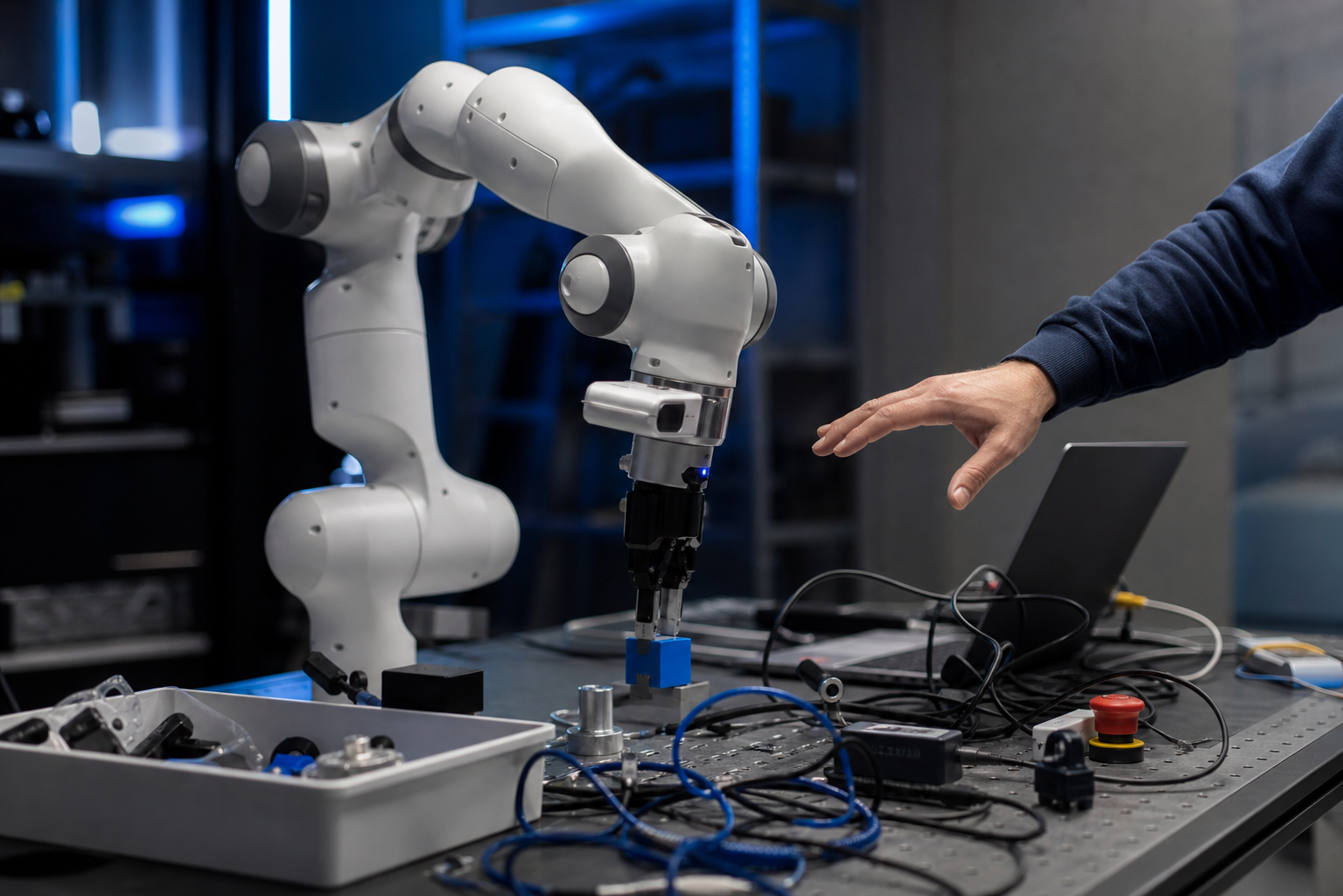
The throughput ceiling is what ties these together — call it the parallelism gap. A single robot's learning rate is capped at the speed of physics in the real world, one attempt at a time, with a human nearby to hit the e-stop. You cannot algorithm your way out of it. The escape is not a smarter optimizer; it is removing the one-at-a-time constraint entirely. Cloud simulation guidance from AWS draws exactly this line, separating single-environment setups — fine for simple tasks — from multiple parallel environments required for complex training scenarios. At a certain task complexity, single-robot iteration is not slow. It is the wrong tool.
What a Simulation Swarm Actually Is
A simulation swarm is coordinated diversity, not mere duplication. It is not N copies of the same trial running in lockstep — it is N variants feeding one learner. That distinction is what separates a swarm from a render farm. The value comes from the differences between instances, not the count of them.
Massively parallel environments — Thousands of physics-simulated robot instances step simultaneously on GPU. Isaac Gym runs both physics and policy learning on the GPU, eliminating CPU-GPU data-transfer overhead and enabling thousands of environments to be stepped in parallel, per SyncedReview. That end-to-end GPU pipeline is the mechanical reason the speedup reaches 2–3 orders of magnitude — no data ever leaves the device between simulating a step and learning from it.
Shared policy, distributed experience — Every instance feeds its trajectories into one central learning policy. The swarm is not N separate learners racing each other; it is one brain harvesting N streams of experience at once. This is the structural difference that matters: a thousand instances do not produce a thousand policies, they produce one policy that has effectively lived a thousand parallel lifetimes in the time a single robot lives one.
Domain randomization — Each instance varies lighting, textures, friction, mass, and latency. Randomly varying these dynamics in simulation is the de facto technique for making a policy generalize to the real world, according to Weng. A policy trained across ten thousand slightly different physics worlds learns the invariant structure of the task rather than memorizing one exact configuration it will never see again on hardware.
Cloud elasticity — Swarm size scales to available compute, not to the size of your physical fleet. You do not buy 4,000 robots; you rent 4,000 environments for the duration of a training run and release them when it finishes. Your parallelism budget becomes a compute-hours line item instead of a capital expenditure in actuators.
Time compression — Simulation runs faster than real-time, multiplying throughput a second time on top of parallelism. Parallelism widens the pipe; time compression speeds what flows through it. A swarm gets both multipliers at once, which is how minutes of wall-clock time absorb what would be months of sequential physical trials.

How Real-to-Sim Capture Feeds the Swarm
A swarm is only as valuable as the world it trains inside. Garbage geometry in, garbage policy out. Before any instance spins up, the real environment has to get into the simulator — and the fidelity of that capture directly determines the size of your sim-to-real gap. If the simulated warehouse's shelf spacing, floor friction, and object masses match reality, the policy transfers cleanly. If they diverge, the policy learns to exploit a fiction: a shortcut that works beautifully in a world that does not exist and fails the instant it meets the real floor.
Production pipelines already run this loop end to end. NVIDIA's Mega blueprint and OSMO orchestration train and test robot fleets inside physically accurate digital twins of warehouses and factories, then deploy to the real facility — a full path from capture to cloud simulation to fleet deployment. The capture stage is the foundation the entire swarm stands on.
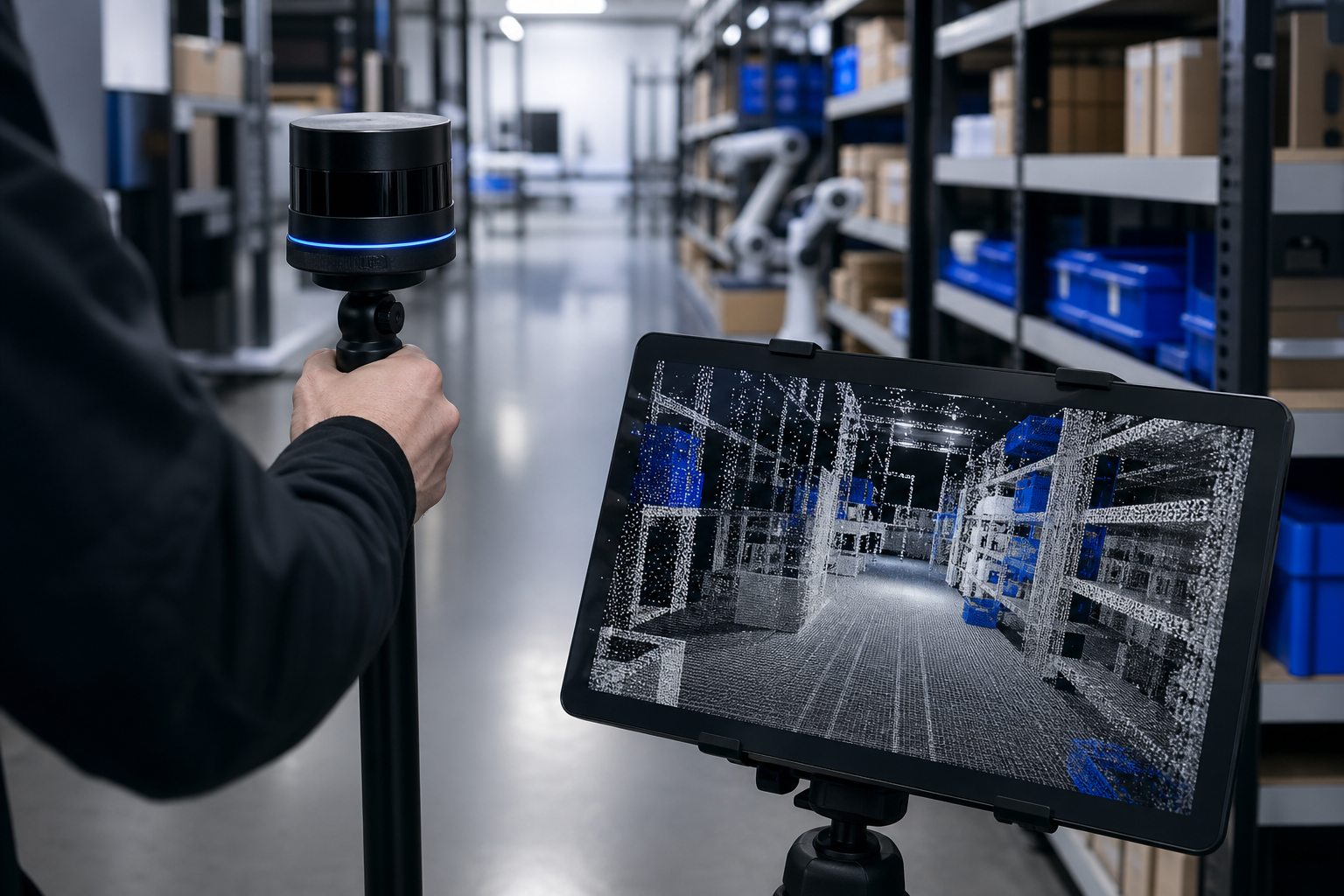
- Scan the physical environment — Use a LiDAR / real-to-sim pipeline to capture the geometry of the actual operating space. This is the ground truth: the real aisle widths, the real shelf heights, the real clutter your robot will actually navigate, not an idealized CAD approximation of them.
- Reconstruct geometry and physics properties — Convert the scan into a simulation-ready scene with collision meshes and material and friction attributes. Geometry alone is not enough; the policy needs to feel the right contact dynamics, so surfaces get material properties that determine how the robot slips, grips, and pushes.
- Instantiate across the swarm with randomized variants — Replicate the scene thousands of times, each with perturbed lighting, friction, and object placement so the policy cannot overfit one exact layout. Randomizing these variants is what Weng identifies as the mechanism that makes a captured scene generalize instead of becoming a trap.
- Attach the target robot's kinematic model — Load the specific robot, whether humanoid, quadruped, or manipulator, so training reflects its real joint limits, reach, and dynamics. A policy trained against the wrong kinematics learns motions the real hardware physically cannot execute.
- Launch parallel training against the task reward — Kick off the swarm; every instance optimizes toward the defined reward simultaneously, harvesting experience across all the randomized copies of your captured world at once.
Swarm Training vs. Real-World Training: When Each Wins
This is not sim-versus-real ideology. It is task-fit. The right question is which approach matches the sample complexity, safety profile, and validation tolerance of the specific skill you are shipping.
| Criterion | Simulation Swarm | Physical Iteration | Hybrid (Sim-First, Real-Finetune) |
|---|---|---|---|
| Throughput | Thousands of parallel trials | One trial at a time | Sim volume + targeted real trials |
| Training speed | 2–3 orders faster (GPU sim) | Real-time only | Bulk in sim, finetune real |
| Hardware risk | None during training | High (falls, wear) | Low — risk only at finetune |
| Reproducibility | Fully logged/controllable | Drifts (lighting, wear) | Controlled sim + monitored real |
| Sim-to-real gap | Present until validated | None (native to real) | Managed via randomization + finetune |
| Best-fit task | Complex, contact-rich, locomotion | Simple, low-sample tasks | Most production skills |
The simulation swarm dominates for high-sample, contact-rich, and locomotion tasks where physical trials are slow or dangerous. The AWS guidance is explicit about reserving parallel environments for complex training scenarios, and the throughput advantage the swarm holds — thousands of trials against one at a time — is what makes those scenarios tractable at all. Where a single arm would need months of real time, the swarm delivers convergence in hours.
Physical iteration still matters for the last mile. LinkedIn's simulation-based training guidance frames simulation as the starting point, with robots still deployed and refined in real settings. The operational precedent runs deep: Space Force's cloud-based "Swarm" digital range connects units into a shared simulated environment specifically to escape sequential, isolated training on physical ranges, as reported by DefenseScoop. The pattern is the same whether you are training guardians or quadrupeds — parallelism in simulation, validation in reality.
The pragmatic verdict is hybrid. Train at scale in simulation first, then use real-world trials as the final validation, mirroring LinkedIn's begin-with-simulation, test-adaptability, transfer-to-reality sequence. Reproducibility is the tiebreaker most teams underweight: physical conditions drift, which Weng identifies as corrupting the signal RL depends on, while the swarm logs and controls every variable. You get the clean training signal in simulation and the honest final grade on hardware.
The winning workflow isn't sim or real — it's sim at scale, then reality as the final exam.
The Infrastructure Behind Swarm-Scale Training
Running a swarm is not a single tool. It is a stack, and every layer has to exist before the first instance spawns. Reference architectures make the shape concrete. The AWS production pattern runs multiple Isaac Sim environments in parallel on Amazon EKS nodes, visualized via Amazon DCV, with AWS Batch as the auto-scaling and job-management alternative. NVIDIA's OSMO orchestration platform scales multi-stage, multi-container workloads — synthetic data generation, reinforcement learning, software-in-the-loop — across hybrid cloud for humanoids, AMRs, and industrial manipulators. And Isaac Lab extends GPU-native simulation to high-fidelity physics and photorealistic rendering across multi-GPU and multi-node configurations, beyond single-node capacity, unifying physics, rendering, actuator models, sensor simulation, data pipelines, and domain randomization into one stack.
GPU-accelerated physics simulation — The parallel-environment engine. Isaac Gym and Isaac Lab step thousands of environments on GPU with integrated physics, sensor simulation, and actuator models, per NVIDIA Research. This is the layer that turns compute into throughput, and it is the hardest single piece to stand up correctly from scratch.
Pretrained RL policies — Warm-start the swarm instead of learning from zero. Starting from a policy that already knows the rough shape of locomotion or grasping cuts the interaction steps needed to converge on a usable skill, which directly attacks the sample-inefficiency problem that makes RL expensive in the first place.
Orchestration and scaling layer — Spins swarm instances up and down and manages jobs across the run. AWS uses EKS plus Batch; NVIDIA uses OSMO for multi-container, multi-stage workloads across hybrid cloud. This is the layer that decides whether your 4,000 environments actually run in parallel or bottleneck against each other.
Packaging and deployment target — Edge hardware to receive the trained policy after the run. Without a deployment path, a trained policy is a file, not a working robot. The target device — a Jetson-class edge box — has to be part of the plan from the start, not an afterthought bolted on at the end.
Framework layer — An open-source robotics AI framework and edge stack that ties capture, training, and deployment together, ideally ROS2-compatible so it drops into existing robotics codebases. This is the connective tissue; without it the other four layers are separate projects you have to integrate yourself.

Assembling this stack in-house means standing up GPU clusters, an orchestration layer, physics engines, and a deployment target — plus the ML expertise to tune all of it. A managed swarm platform built on an open-source robotics AI framework, ROS2-compatible, with an edge stack to receive the trained policy, collapses that into a subscription. Which path makes sense depends entirely on where your scarcest resource sits — the final section makes that call explicit.
From Swarm to Robot: Closing the Sim-to-Real Gap
Moving a swarm-trained policy onto physical hardware is the hardest mile. A policy that hits target reward in a thousand parallel worlds can still collapse the moment it touches reality. Domain randomization is what makes the transfer survive: by training across randomized textures, lighting, friction, and dynamics, the policy learns to be robust to a reality it has not seen exactly, per Weng. The randomization is not decoration during training — it is the entire mechanism by which sim experience becomes real-world competence.
But randomization is not a magic bullet, and pretending otherwise is where transfer projects die. Weng cautions plainly that it can fail if the randomized distribution does not adequately cover real-world conditions. DROPO exists precisely because ad hoc, hand-tuned randomization can be unsafe; it estimates randomization distributions offline to reduce transfer risk, according to the ScienceDirect paper. And in his CS287 lecture on sim2real, UC Berkeley professor Pieter Abbeel stresses that simulators must include the hardest objects and conditions — not just easy cases — for grasping policies to survive transfer. LinkedIn's guidance reinforces the point from the workflow side: simulation is a starting point, and real-world deployment and refinement remain mandatory.
Domain randomization only protects you against the variation you remembered to simulate.
- Validate in high-fidelity sim before export — Confirm the policy hits target reward under the widest randomization range, including the hardest cases Abbeel warns you not to skip. A policy that only survives the easy configurations is not ready to leave the simulator.
- Package the policy for the target edge device — Compile for the specific edge hardware that will run it in production, matching the compute and runtime the real robot actually carries.
- Deploy to hardware — Push the packaged policy via a one-click or edge-stack deployment path, so the trip from trained file to running robot is a step, not a subproject.
- Run supervised real-world validation trials — Test on the physical robot with an operator and e-stop present. Simulation is only the first stage, per LinkedIn, and the first real trials are where you learn what the swarm missed.
- Fine-tune on physical data if performance drifts — If the sim-to-real gap shows, collect targeted real trajectories and refine. Drift is direct evidence the randomization distribution did not fully cover reality — the exact failure mode Weng and the DROPO authors warn about.
- Monitor and iterate — Track performance in deployment and re-capture or re-randomize as the environment changes. A policy validated against last quarter's warehouse is not automatically valid after the shelving gets rearranged.
Evaluating a Simulation Swarm Approach: A Team Decision Guide
The build-versus-subscribe call is not a matter of taste. It falls out of three attributes: your task's sample complexity, your in-house ML depth, and how fast you need the first working skill. Find your row.
| Team Profile | Task Sample Complexity | In-House ML Depth | Leaning | Time-to-First-Skill |
|---|---|---|---|---|
| Robotics startup, no ML PhDs | Often high | Low | Subscribe | Fast (managed swarm) |
| Industrial integrator at scale | High, repeated | Medium | Subscribe or hybrid | Fast once templated |
| Academic / maker on ROS2 | Variable | Medium–High | Build (open-source) | Slow but educational |
| Enterprise fleet operator | High, multi-site | Medium | Subscribe (managed) | Fast per site |
Three questions decide which row you actually live in. First, what is my task's sample complexity? High-sample, contact-rich, or locomotion tasks push you hard toward the swarm — AWS reserves parallel environments for exactly these complex scenarios, and a simple pick-and-place with a low sample count may not justify the machinery at all. Second, do I have GPU budget and orchestration expertise? Building the EKS and Batch or OSMO-style stack in-house is real engineering, not a weekend integration, as both AWS and NVIDIA's reference architectures make clear. Third, how tight is my sim-to-real tolerance? Tighter tolerance means more investment in randomization design and physical finetuning — the DROPO work from ScienceDirect and Weng's coverage caveats show that getting transfer right is its own specialized discipline.
The decision logic reduces cleanly. If your scarcest resource is compute budget, building your own stack may pay off over enough runs. But if your scarcest resource is ML expertise — the reward-shaping, the randomization tuning, the orchestration engineering — then renting the swarm beats building it every time. A subscription-based managed platform collapses the whole capture-to-swarm-to-deploy pipeline into weeks you do not have to staff a research team to survive.
If your team's ML expertise is scarcer than your compute budget, the swarm should be rented, not built.
Simulation Swarm FAQ
Does a simulation swarm work for any robot type?
Yes — swarm-scale simulation is hardware-agnostic across humanoids, quadrupeds, and manipulators. NVIDIA's OSMO orchestration explicitly scales simulation workloads for humanoids, AMRs, and industrial manipulators across hybrid cloud. The requirement is a correct kinematic model of the target robot, attached during scene setup so training reflects the machine's real joint limits, reach, and dynamics rather than a generic stand-in.
How big does a swarm need to be to matter?
Big enough to break the one-at-a-time ceiling of physical training. GPU-native simulation steps thousands of environments in parallel and delivers the 2–3 orders of magnitude speedup over CPU-based simulators reported by SyncedReview. AWS's rule of thumb sizes it by task: simple tasks may need one environment, complex tasks need many parallel ones. Let the task complexity set the count.
Will a swarm-trained policy work if my real environment changes after scanning?
Partly — that is what domain randomization is for. Training across randomized friction, lighting, and layout builds robustness to variation, per Weng. But randomization cannot cover conditions it never sampled, the same source cautions, so large layout changes — new shelving, a reconfigured cell, a different floor surface — warrant a fresh scan and a new training run rather than hoping the old policy generalizes that far.
Do I need reinforcement learning expertise to use swarm training?
Not on a managed platform. Pretrained RL policies warm-start training so teams are not authoring reward functions and tuning randomization distributions from scratch. The sample-inefficiency and data-cost problems that make deep RL expertise expensive to hire, which Weng identifies as the core reason simulators are essential, are exactly what a managed swarm abstracts away behind the subscription.
How is a simulation swarm different from a standard robot simulator?
A standard simulator runs one virtual robot; a simulation swarm runs thousands in parallel, each with randomized dynamics, all feeding one shared learning policy. Isaac Lab formalizes this as GPU-native, multi-GPU and multi-node simulation for large-scale learning beyond single-node capacity. The shift is not just scale — it is the coordinated diversity of instances resolving into a single, more general policy.