
Essential Robotics Maintenance: A Step-by-Step Preventive Care Guide

You own the uptime number. Whether you run five Franka arms in a lab, twenty Universal Robots cobots on an assembly line, or fifty Unitree quadrupeds across an inspection contract, the spreadsheet your CFO actually reads tracks one column — hours the fleet was producing versus hours it was not. Robotics maintenance is the only operational lever that moves that column without buying more hardware. It is also the lever most teams treat as housekeeping until a $40 cable takes out a $30,000 cell.
This playbook is built for operational decision-makers running heterogeneous robot fleets. It covers the economics, the three failure domains you must monitor, a tiered inspection cadence, the tooling that actually scales past ten units, and a 90-day rollout you can begin Monday morning.
Table of Contents
- The True Cost of Skipping Robotics Maintenance
- The Economics of Preventive vs. Reactive Maintenance
- The Three Failure Domains Every Program Must Cover
- The Tiered Robotics Maintenance Checklist
- Tools, Telemetry, and Logging Systems for Fleet-Scale Maintenance
- Predictive Maintenance and Production-Floor Reality
- Your 90-Day Robotics Maintenance Rollout Plan
- Frequently Asked Questions
The True Cost of Skipping Robotics Maintenance
Start with the financial shockwave. Unplanned downtime costs global manufacturers an estimated $1.4 trillion per year, with most plants absorbing 20–60 hours of unplanned downtime annually, according to Siemens, The True Cost of Downtime 2024 (vendor source). In high-throughput environments, unplanned downtime reaches $260,000 per hour in lost production, labor, and recovery costs, per Aberdeen Research cited by PatentPC.
Make it visceral with the math that lands in a budget meeting. Robotics247 models a conservative $1,000/minute downtime cost. Multiply that by a single 15-minute unplanned stoppage per week and you get $780,000 per year, or roughly $3.9 million over a five-year deployment. One missed bearing inspection can compound into a million-dollar lesson — and that is the conservative case. North American facility managers in the same Robotics247 reporting cite downtime costs as high as $10,000 per minute in some operations.
Preventive maintenance is not a checklist you complete. It is a data-reading discipline you build into your operations rhythm.
This matters specifically for robotics teams because of how cost of ownership distributes. Research by Rashidi Asari, summarized in the same Robotics247 article, shows operational costs — power, downtime, maintenance — reach approximately 40% of a robot's total cost of ownership over its life. Acquisition is only the other 60%. Teams that optimize purchase price but ignore maintenance economics underestimate lifecycle cost by enormous margins.
So why do standard vendor maintenance docs fail in real fleets? Three structural reasons.
They assume single-model, single-use-case deployment. A FANUC schedule built for a 6-axis arm welding car frames does not map to a quadruped doing pipe inspections. Most teams now run heterogeneous fleets — Unitree quadrupeds, Franka manipulators, Universal Robots cobots, custom mobile platforms — and vendor PDFs do not compose. You end up with three binders, three intervals, and no shared signal.
They are calendar-based, not condition-based. FANUC recommends extensive inspections around 3,850–7,700 operating hours for many models. That is a useful baseline. But a robot running in a dusty foundry hits failure conditions far faster than one in a clean assembly cell. Hours-since-install is a weak proxy. Current draw, thermal signature, and error rates are stronger.
They ignore the software layer. OEM manuals cover lubrication intervals and torque specs but rarely address firmware drift, calibration regression, or sensor degradation — which now drive a meaningful share of operational failures in modern controllers. A robot that passes every mechanical check can still ship out-of-tolerance parts because a firmware patch quietly retuned its PID loop.
Here is the alternative anchor. Structured preventive maintenance, per the U.S. Department of Energy O&M Best Practices Guide, delivers 12–18% lower total maintenance costs, 70–75% fewer breakdowns, and 20–25% higher production versus run-to-failure. Plants in reactive mode burn over 50% of maintenance labor on unplanned work. Best-practice facilities keep that figure under 10%.
The rest of this guide is a playbook for moving from reactive to a tiered, telemetry-informed preventive program — covering the three failure domains, an inspection cadence you can adopt this quarter, the tooling that makes it scale, deployment-time tradeoffs by environment, and a 90-day rollout you execute one phase at a time.
The Economics of Preventive vs. Reactive Maintenance

The DOE figures above are not aspirational. They are observed across decades of industrial asset data. Translated to robotics, they reshape the budget conversation.
A 50-robot fleet generating $200K/month in throughput would, under reactive maintenance, lose roughly $40K–$50K per month to unplanned events when you apply the DOE benchmark of >50% unplanned labor share alongside the Robotics247 downtime models. Moving to preventive maintenance halves that loss within a year of disciplined execution.
The 12–18% maintenance cost reduction is not about doing less work. It is about doing the right work at the right time. Replacing a bearing during a planned 30-minute window costs around $500 in labor and parts. Replacing the same bearing after it seizes and damages the gearbox costs $5,000–$50,000 — gearbox plus collateral damage to encoders, harnesses, and any product in the cell at the moment of failure. The 20–25% production uplift compounds two effects: fewer unplanned stops, and steadier robot performance, because calibrated joints move faster and more accurately than worn ones.
The counter-point you need to hear: preventive maintenance is not free. It requires technician time, telemetry tooling, and the discipline to halt working robots for inspection. The math only works when you track the avoided cost. ConnectRF (vendor source) models the partial-downtime case precisely: in a warehouse processing 10,000 picks/day, an extra 5 seconds of delay per pick equates to 3,500 lost labor hours per year — about $59,000 in labor alone at typical wages. Those micro-delays are invisible without logging, which is exactly why telemetry-backed tracking becomes the operational center of any serious program.
Continuous telemetry from an edge stack like OpenKinematics' OpenBrain surfaces these micro-delays automatically, so teams can attribute slowdowns to specific joints, sensors, or firmware revisions rather than chase ghosts across three vendor dashboards.
The Three Failure Domains Every Program Must Cover
| Failure Domain | Common Warning Signs | Inspection Cadence | Cost If Ignored |
|---|---|---|---|
| Mechanical (joints, gearboxes, bearings, harmonic drives) | Acoustic noise, jerky motion, reduced speed, elevated motor current, thermal warnings | Daily visual + monthly detailed + quarterly tear-down | Gearbox seizure or harmonic drive replacement: $5K–$50K plus downtime |
| Electrical (connectors, harnesses, capacitors, drives, E-stop circuits) | Intermittent faults, voltage spikes, port corrosion, cable abrasion, IEC 60204-1 failures | Monthly visual + quarterly electrical audit | Cascading drive failure, safety shutdown, controller damage |
| Software / Firmware (controller firmware, calibration, sensor drift, ML policy regression) | Calibration drift vs. ISO 9283 spec, perception inconsistencies, log error spikes | Continuous telemetry + monthly validation runs | Silent performance degradation, unsafe behavior, scrapped product |
Research by Muntean et al. (Maintenance and Reliability of Industrial Robots, 2014) consistently shows that mechanical joints and gearboxes, along with electronic drives and controllers, account for the majority of industrial robot failures — with software and configuration issues representing a growing share. That empirically validates the three-domain structure as the right organizing model.
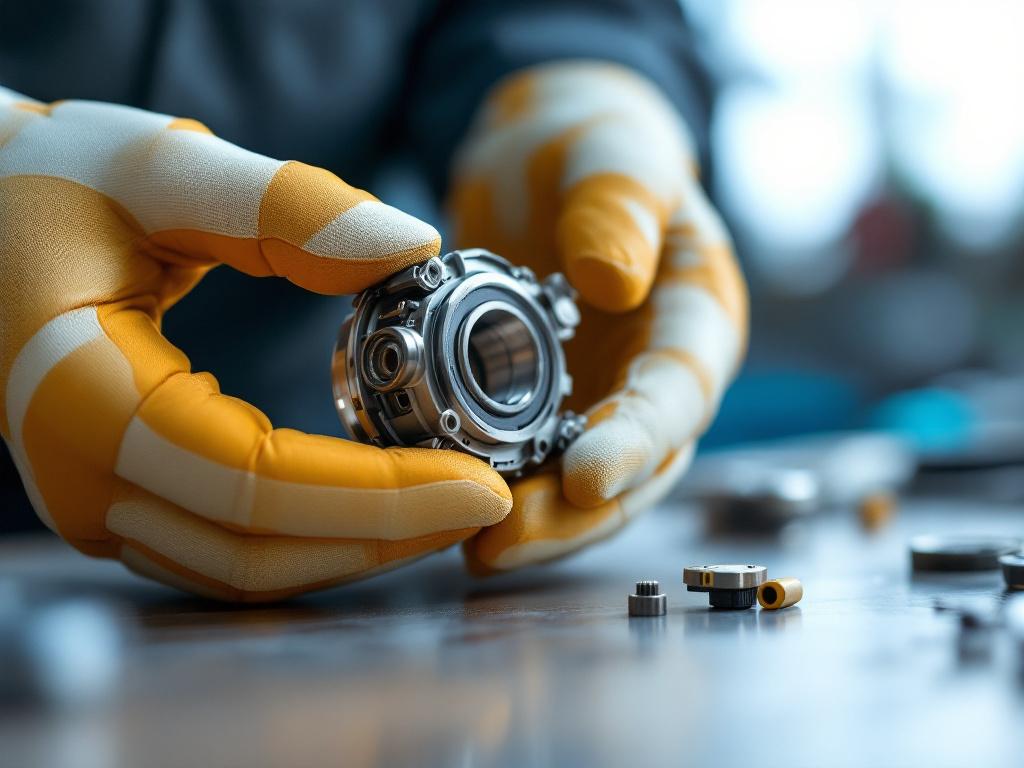
The part most teams miss is how the domains interact.
Electrical noise degrades software performance. A frayed encoder cable does not always trigger an error. It introduces signal noise that degrades calibration, which the perception stack then interprets as drift. The software team chases ghosts for two weeks. The actual fix is a $40 cable.
Mechanical friction increases current draw before it makes noise. A bearing on its way out pulls 10–15% more current to maintain commanded speed. Your motor controller logs this weeks before your ears can hear the grinding. If you are not monitoring current trends, you miss a 4–6 week warning window — exactly the window in which intervention is cheap and non-disruptive.
Firmware updates can invalidate mechanical calibration. A controller firmware patch may change PID tuning. If you do not validate against ISO 9283 repeatability tests after firmware changes, you ship robots with silent regression for weeks before quality flags it downstream.
A thermal spike or firmware error is your robot asking for help before it breaks. The question is whether you have built the systems to listen.
The compliance frame matters too. ISO 10218-1/-2 and the harmonized ANSI/RIA R15.06 explicitly require structured maintenance modes and documentation for industrial robots. IEC 60204-1 mandates periodic verification of protective bonding, insulation, and emergency-stop integrity. These are not optional best practices — they are compliance requirements for any team operating industrial robots in the U.S. or EU.
Close on the diagnostic insight that drives everything in Section 5. Visual inspection alone catches mechanical issues reasonably well but misses the majority of electrical and software-domain failures, which present as data anomalies long before they present as physical symptoms. This is why telemetry is non-negotiable for any fleet larger than a handful of robots.
The Tiered Robotics Maintenance Checklist

What follows is a baseline that teams adapt to their specific hardware. FANUC, Universal Robots, and KUKA all publish their own intervals. These tiers are designed to compose with OEM guidance, not replace it.
Daily — 5 to 10 Minutes Per Robot
- Visual sweep. Look for visible damage, loose fasteners, frayed cables, fluid leaks at joints.
- Telemetry check. Pull the last 24 hours of temperature, error logs, and uptime metrics from your fleet dashboard.
- End-effector function test. Confirm gripper or tool responds correctly to a known command.
- Log anomalies. Even minor ones. Anything outside baseline goes in the log.
Weekly — 20 to 30 Minutes
- Clean sensors. LiDAR windows, cameras, depth sensors. Use lint-free wipes and manufacturer-approved solvents. Regulated dry compressed air for connectors.
- Inspect bearing seals and joint covers. Look for dust or debris intrusion.
- Run calibration spot-check. Drive the robot to a known pose; verify position repeatability against ISO 9283 tolerance for your model.
- Review motor current draw trends. Flag any joint pulling more than 10% above its 30-day baseline.
Monthly — 1 to 2 Hours
- Disassemble and inspect high-wear joints. Gripper fingers, wrist, base. Replace seals showing wear.
- Electrical audit per IEC 60204-1. Verify protective bonding continuity, measure voltage rails, inspect every connector for corrosion or arcing.
- Firmware and stack validation. Run full diagnostic suite. Check for OEM firmware updates. After any firmware change, re-run ISO 9283 repeatability tests.
- Lubrication renewal. Only where OEM spec calls for it. Over-greasing causes dirt accumulation and is a leading cause of premature bearing failure.
- Update maintenance log. Findings, actions taken, flagged items, telemetry snapshot.
Quarterly — Half Day Per Robot or Staggered Across Fleet
- Full tear-down inspection of critical assemblies — gearboxes, harmonic drives, controller cooling.
- Replace wear items per OEM intervals — brushes, seals, lubricants, cable harnesses showing fatigue.
- Recalibrate end-effectors and external sensors, especially after any mechanical work.
- Fleet-wide trend analysis. Compare current draw, error rates, and inspection findings across all robots. Identify pattern failures — for example, "every Franka in Cell 3 shows wrist drift."
- Compliance audit. Confirm ISO 10218 / ANSI R15.06 documentation is up to date.
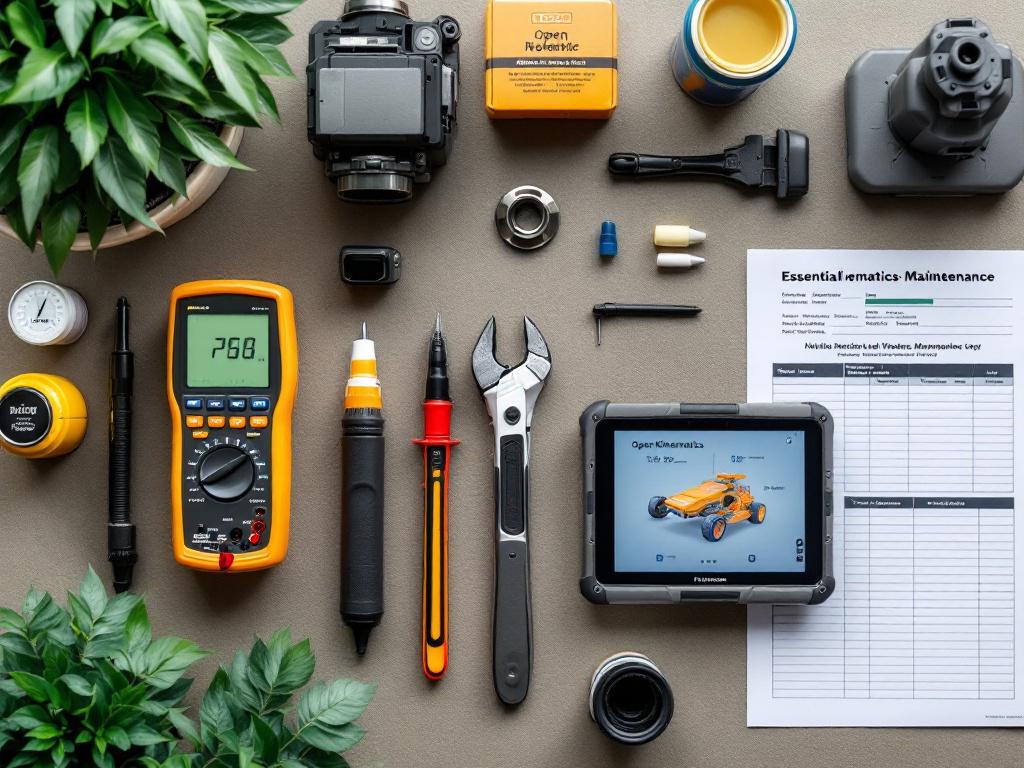
Sidebar — the over-maintenance trap. Greasing weekly when the spec says quarterly causes dirt accumulation and accelerates wear. More is not better. Follow the spec, then let telemetry tell you when to intervene off-cadence. Discipline runs in both directions.
Tools, Telemetry, and Logging Systems for Fleet-Scale Maintenance
Essential Physical Tools
- Thermal camera (FLIR-class or equivalent). Detects bearing friction and motor overload 4–6 weeks before audible or visible symptoms. Non-negotiable for any fleet over 5 robots.
- Digital multimeter with current clamp. Voltage, continuity, and motor-current measurement. Required for IEC 60204-1 electrical verification.
- Torque wrench set. Joint fastener re-torquing per OEM spec. Under-torque causes vibration; over-torque damages threads.
- Lubricants matching OEM spec, typically ISO VG 32–68. Wrong viscosity degrades performance silently. Check the manual for every model in your fleet.
- Dry compressed air system (regulated, oil-free). Sensor and connector cleaning without moisture risk.
Telemetry and Diagnostic Software
- OEM diagnostic suites. FANUC Roboguide, Universal Robots PolyScope, Franka Desk, Unitree app. Each captures controller logs and runs built-in tests for its own hardware.
- Fleet management platform. Centralizes telemetry across heterogeneous hardware. This is where the OpenBrain edge stack and a unified cloud telemetry layer add value — one dashboard across Unitree, Franka, UR, and custom platforms, eliminating per-vendor app sprawl.
- Time-series database for current and temperature trends. Even a basic Grafana plus InfluxDB stack beats spreadsheets for trend detection across more than ten robots.
Maintenance Log Structure
Minimum fields for every log entry:
- Robot ID and platform
- Inspection date and tier (daily / weekly / monthly / quarterly)
- Inspector name
- Telemetry snapshot at time of inspection (current draw per joint, temperatures, error counts)
- Findings (free text)
- Actions taken (parts replaced, calibrations performed, firmware versions)
- Next scheduled review date
The critical principle: link logs to telemetry. A finding of "gripper feels loose" means little without the current-draw history that shows it pulling 12% above baseline for nine days. Manual findings plus telemetry data is how you correlate symptoms to causes across a fleet.
Alert Thresholds (Automation Layer)
Set automated alerts at:
- Motor current draw ±15% from joint-specific 30-day baseline. Indicates friction increase or load anomaly.
- Firmware or software error rate above 5 per hour. Indicates calibration drift, sensor corruption, or controller fault.
- Sensor variance. LiDAR consistency scores or gripper position repeatability falling outside ISO 9283 tolerance for the model.
- Thermal delta. Any joint or drive running more than 8°C above its peer average under similar load.
Rule of escalation: any alert triggers a visual and electrical inspection within 48 hours. Document whether the alert was a true positive. Over time, you tune thresholds to your fleet's signature.
Common Mistakes to Avoid
- Over-maintenance. Greasing weekly when spec says quarterly accelerates wear via contamination.
- Under-logging. Logging only failure events means you never see degradation curves. Log every inspection, even uneventful ones.
- Ignoring software diagnostics. Most modern robots stream thermal, electrical, and performance data continuously. Teams that only check it after a failure waste 80% of the data's value.
- Single-platform tooling assumptions. If you run Franka plus UR plus Unitree, you need a layer above OEM apps. Otherwise three technicians check three dashboards and no one sees fleet-wide patterns.
Predictive Maintenance and Production-Floor Reality
Three maintenance philosophies, plainly:
- Reactive. Fix when broken. Cheapest per event. Most expensive per year.
- Preventive. Scheduled by calendar or operating hours. Predictable. Sometimes wasteful when parts had life left.
- Predictive. Data-driven. Telemetry signals trigger intervention. Most efficient when the data infrastructure exists.
The DOE benchmark again: predictive layered on preventive is where best-practice plants land — under 10% of maintenance hours unplanned, against the over-50% figure in reactive shops. Mike Bradford, Global Industry Director for Manufacturing at Infor (vendor source), summarizing DOE-aligned data, states that plants moving from run-to-failure to structured preventive and predictive regimes "regularly see double-digit reductions in maintenance cost and dramatic cuts in unplanned downtime."
Predictive maintenance is not about guessing when failure happens. It is about reading your robot's own data to schedule intervention before performance degrades below tolerance.
The operational truth: predictive maintenance is not magic. It requires three things — continuous telemetry, baselines specific to your fleet and duty cycle, and someone who reads the data weekly. Teams that buy a "predictive maintenance" tool and do not staff the reading discipline get exactly the same downtime as before, plus a software bill.
Now translate that into three deployment scenarios with specific guidance.
Scenario 1 — 24/7 Warehouse Fleet (50+ Mobile Robots)
High downtime cost. Robotics247 modeling puts this above $1,000 per minute for high-throughput facilities. Strategy: stagger maintenance windows across the fleet so 5–10% of units are always in scheduled service. Keep 2–3 spare units pre-configured for hot-swap. Predictive alerts schedule deep maintenance during the 02:00–05:00 low-demand window.
Acknowledge the capital reality. Per Supply Chain Dive reporting on Interact Analysis data, Ash Sharma of Interact Analysis notes that fully equipping a warehouse with mobile robots can "cost as much as $1 million on average," and one-third of surveyed companies cite lack of budget as the top adoption barrier. At that capital intensity, maintenance ROI compounds fast — every avoided week of unplanned downtime on a $1M deployment changes the payback curve.

Scenario 2 — Synchronized Assembly Line (5–20 Manipulators)
Line stoppage is the cost; a single robot down often halts the line. Strategy: build 30-minute maintenance buffers into shift changeovers. Use changeover slots for daily and weekly tasks. Schedule monthly and quarterly work during planned line shutdowns. Stage spare end-effectors and harnesses so a stoppage is a swap, not a rebuild.
Scenario 3 — R&D or Academic Lab
Variable duty. Uptime pressure low. Data integrity matters. Strategy: use deployment as a data-gathering phase. Log everything. Establish your own baselines over 4–6 weeks because OEM defaults will not match your duty profile. This is where most teams discover their robot has been drifting for months — and where you build the operator habits that scale when the lab project becomes a product.
A counter-narrative worth keeping on the desk: Supply Chain Management Review argues that fully autonomous warehouses remain out of reach because SKU, packaging, and workflow variability require human oversight. Maintenance, exception handling, and adaptation are ongoing costs, not one-time setup. Plan for it in your operating budget, not just your capital budget.
Your 90-Day Robotics Maintenance Rollout Plan
This is not a recap. It is the working plan you execute starting Monday.
Phase 1 — Weeks 1–2: Audit Your Current State
- Inventory all robots (model, age, duty hours, current failure rate per quarter).
- Collect OEM maintenance schedules for every unique model. Link or store PDFs centrally.
- Identify current maintenance ownership: in-house technician, OEM contract, third-party integrator, or no one.
- Document last maintenance event for each robot. If you have no records, note the gap explicitly.
- Calculate current downtime cost: (lost throughput per hour) × (average downtime hours/month). Use the $1,000/minute baseline as a placeholder if you have no internal data yet.
Phase 2 — Weeks 3–4: Design Your Protocol
- Choose a logging system. Spreadsheet is the minimum acceptable starting point; fleet management software is preferred for 10+ robots.
- Adapt the daily / weekly / monthly / quarterly checklist to your specific hardware and duty profile.
- Define alert thresholds. Start with the defaults (±15% current, >5 errors/hour, ISO 9283 tolerance). Tune to your fleet over 60 days.
- Assign ownership by tier. Daily and weekly to floor technicians; monthly and quarterly to a senior maintenance lead.
- Schedule the first training session — 90 minutes, walking through checklist, log structure, and alert response.
Phase 3 — Weeks 5–8: Pilot on One Fleet Segment
- Run the full protocol on 1–3 robots as a dry run.
- Time every task. Adjust intervals if reality differs from estimates.
- Collect baseline telemetry: motor current per joint, temperatures, error rates, calibration deltas.
- Document every deviation from expected. These become your tuning data.
Phase 4 — Weeks 9–12: Scale and Monitor
- Roll out to full fleet.
- Set up a weekly 30-minute team sync to review alerts, logs, and patterns.
- Compare manual log findings against telemetry data. Confirm correlations.
- Plan the quarterly review: which intervals worked? Which thresholds were over- or under-tuned? Which robots showed the most pattern failures?
Briefing Template — Fleet Maintenance Status
| Robot ID | Platform | Next Scheduled | Active Alerts | Owner |
|---|---|---|---|---|
| Unit-01 | Unitree Go2 | 2025-02-12 | Gripper drift 3% (below threshold) | Sarah K. |
| Unit-02 | Franka Panda | 2025-02-20 | None | Marcus L. |
| Unit-03 | UR10e | 2025-02-22 | J3 current +12% (trending up) | Sarah K. |
| Unit-04 | UR10e | 2025-02-24 | None | Marcus L. |
| Unit-05 | Custom AMR | 2025-03-01 | Thermal delta J2 +9°C | Sarah K. |
Adapt the columns to your operating context — many teams add "Last Maintenance," "Notes," and a free-text "Next Action" column once the basics are in place.
One practical closing note. Teams running heterogeneous fleets often find that unified telemetry eliminates the per-vendor monitoring sprawl that breaks this kind of rollout in week 5. The protocol works on any platform. The tooling determines whether it scales past 10 robots without consuming a full-time engineer.
Frequently Asked Questions
When should I retire a robot instead of maintaining it?
Compare annual maintenance cost (labor plus parts) against replacement cost and remaining useful life. Industrial robots are commonly deployed on 5–15 year horizons, with manufacturers planning ROI over 5–7 years, per the IFR World Robotics 2023 report. Rule of thumb: if annual maintenance exceeds about 30% of replacement cost for two consecutive years and the robot is over 7 years old, model the replacement ROI seriously. Also weigh: Are spare parts still available? Is the controller firmware still supported? Are you running on a deprecated software stack? A 10-year-old robot with zero spare availability and an unsupported controller is not worth maintaining — it is worth a planned migration. Do not confuse sunk cost with future value.
I don't have baseline maintenance data. Where do I start?
Start with an audit week. Run the full tiered checklist on every robot in your fleet, even if you do not know what "normal" looks like. Document everything: motor current per joint, joint temperatures, error log frequencies, visible wear. Collect 4–6 weeks of this data before drawing conclusions. That becomes your baseline. From week 7 onward, deviations from your own baseline matter more than deviations from any spec sheet — because spec sheets describe a new robot in a clean lab, and your robot lives in your environment. The most expensive mistake is waiting until you have "good data" to start. The data starts being good the moment you start logging.
Is skipping a quarterly deep maintenance really risky if my robot seems fine?
Yes. Bearing degradation, firmware drift, and electrical corrosion are silent until they are catastrophic. By the time a robot "feels" wrong to an operator, the underlying damage is typically 4–8 weeks old and may already involve collateral wear on adjacent components. Quarterly maintenance catches issues at their inflection point, when they are still reversible with a $500 part rather than a $15,000 assembly. The DOE benchmark of 70–75% fewer breakdowns under structured preventive programs is built specifically on the quarterly-tier discipline. Skip it once and you may get lucky. Skip it as a policy and your unplanned-failure rate climbs back to reactive-shop levels within a year.