Reinforcement Learning for Robots: How RL Policies Power Real-World Robot Skills
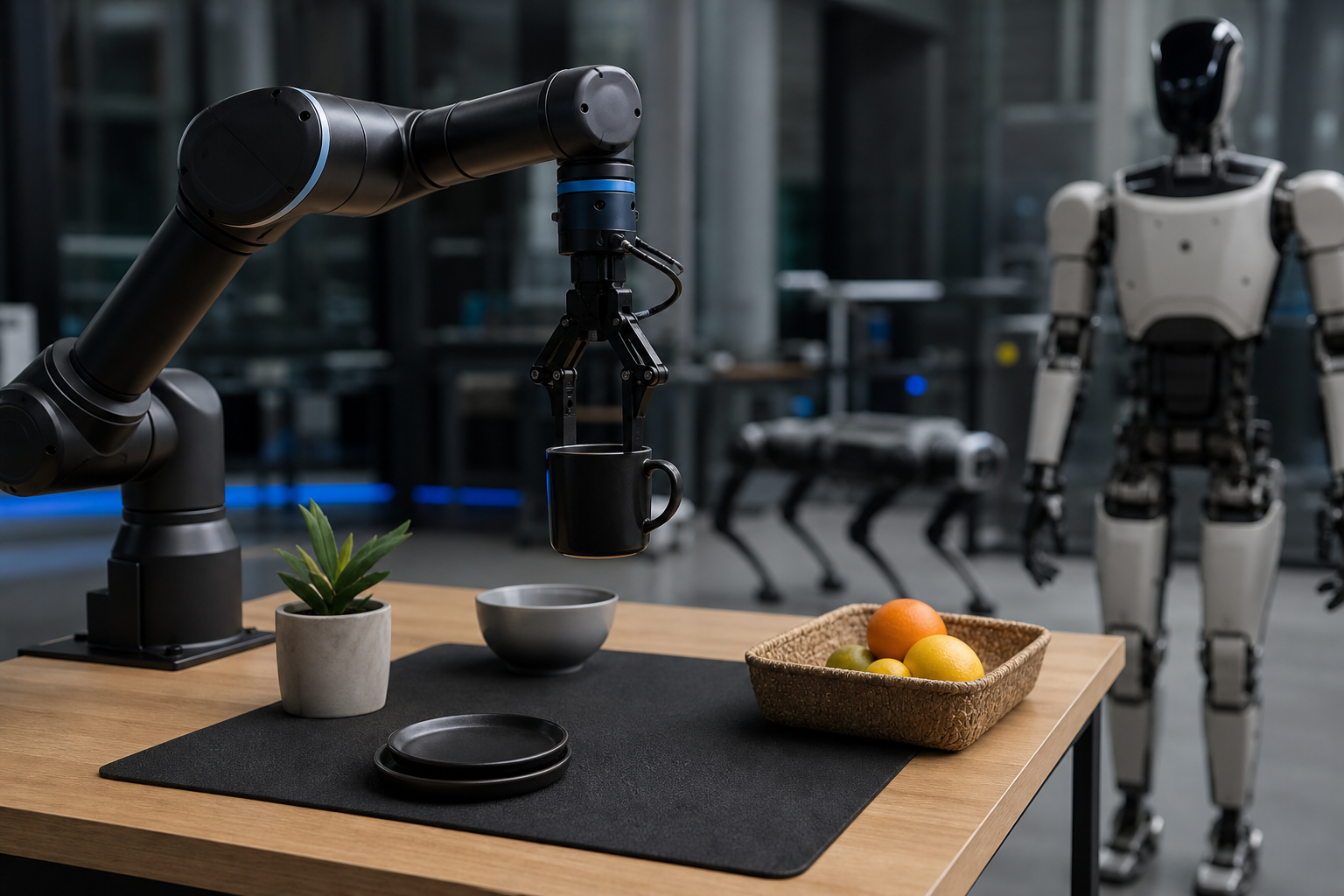
You own the robot. A Franka arm on the bench, a Unitree quadruped in the lab, maybe a humanoid you're still babying through balance tests. And there's a task it can't do yet: contact-rich insertion, walking over gravel that shifts under each footfall, grasping objects that never hold the same pose twice. You're weighing three bad options. Hand-script every behavior and watch it shatter the moment reality varies. Hire ML talent you can't find or afford. Or teach yourself reinforcement learning and lose a quarter to reward tuning and sim-to-real debugging. A reinforcement learning robot policy is the answer everyone points to — but "just use RL" quietly hides reward engineering, simulation setup, and the gap between a perfect simulator run and a real robot on a real floor. Classical control breaks on contact-rich, dynamic, unstructured tasks. RL handles them, at a cost. This article walks how a reinforcement learning robot policy actually becomes a deployed skill — enough to decide when RL is the right tool and what a modern pipeline takes off your plate.
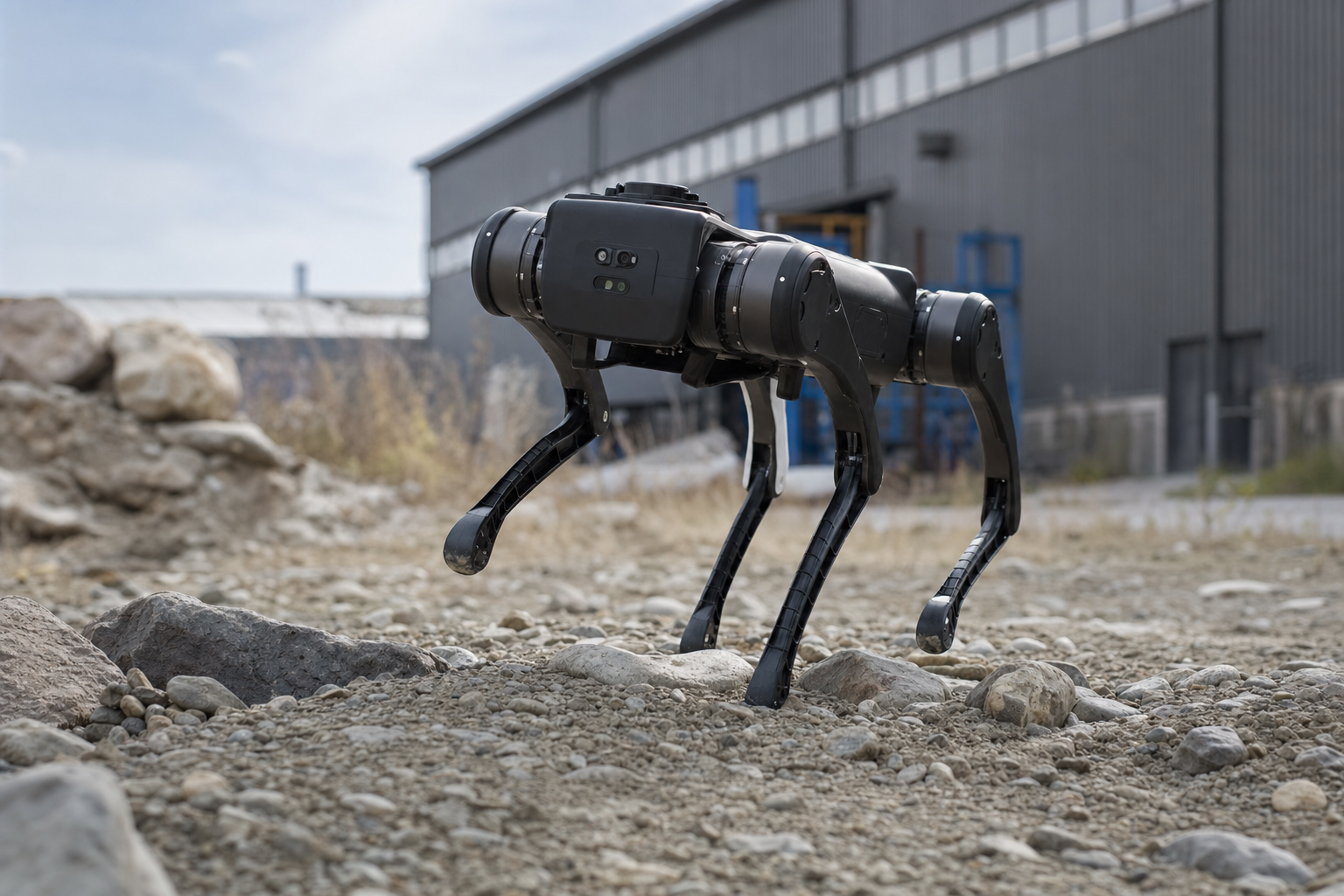
Table of Contents
- When RL Beats Hand-Coding: Choosing the Right Problem
- Anatomy of an RL Policy: What Actually Ships to the Robot
- Train in Simulation, Deploy in Reality: The Sim-to-Real Pipeline
- Reward Engineering & Domain Randomization: Where RL Projects Stall
- Buy, Build, or Fine-Tune: Getting an RL Skill Onto Your Robot
- RL Across Robot Morphologies & Safety Envelopes
- RL Readiness Checklist: Is Your Task Deployment-Ready?
- Frequently Asked Questions
When RL Beats Hand-Coding: Choosing the Right Problem
Before you spend a single GPU-hour, answer one question: does this specific task justify RL over the cheaper alternatives? Four approaches compete for the job, and each has a lane where it wins.
Scripted motion hardcodes waypoints. It's deterministic and offers zero adaptation. Classical control — PID, MPC — is model-based and excellent when your dynamics are known and modelable. Imitation learning learns from human or expert demonstrations; it's reward-free but demonstration-hungry. Reinforcement learning learns from a reward signal through trial and error, and it earns its keep when dynamics are hard to model or the environment refuses to stay fixed. RL + imitation combines them: demonstrations bootstrap exploration, reward refines it.
| Task Characteristic | Scripted | Classical Control | Imitation Learning | Reinforcement Learning |
|---|---|---|---|---|
| Contact-rich manipulation | Poor | Fair | Good | Strong |
| High-dimensional action space | Poor | Fair | Good | Strong |
| Dynamic / fast-changing environment | Poor | Fair | Fair | Strong |
| Hard-to-model dynamics | Poor | Poor | Good | Strong |
| Reward easily defined | Fair | Good | Fair | Strong |
| Fixed geometry, repeatable | Strong | Strong | Fair | Fair |
Read the bottom row carefully. For fixed-geometry, repeatable pick-and-place with known part shapes and fixed fixtures, a scripted or MPC solution is cheaper, more auditable, and far faster to certify. RL there is overkill — you'd burn weeks of training compute to reproduce what a waypoint list does deterministically. Save RL for the top rows: contact-rich manipulation, high-dimensional whole-body control, and grasping under real variation.
RL and imitation are not mutually exclusive. The survey literature on sim-to-real transfer frames imitation learning as one of several method families — alongside domain randomization, domain adaptation, meta-learning, and knowledge distillation — that combine with RL rather than replacing it. And the clearest documented win case for RL is agile locomotion: the Google Research quadruped work and NVIDIA's Isaac Lab locomotion pipeline both show RL mastering the hard-to-model contact dynamics of legged movement that classical control struggles to specify by hand.
RL is not a better hammer — it is the right tool only when the world refuses to hold still.
Anatomy of an RL Policy: What Actually Ships to the Robot
Before you can reason about deployment, you need to know what "a trained policy" actually is as an artifact. It's smaller and more concrete than most teams expect. A reinforcement learning robot policy breaks into five parts.
- Observation space — what the policy sees each timestep. This includes proprioception (joint angles, joint velocities, IMU readings) and often exteroception (LiDAR point clouds, camera frames). Bigger is not automatically better: the Google Research quadruped work found that compact observation spaces actually aided transfer to real hardware. Every extra dimension you feed the policy is another dimension the simulator has to get right.
- Action space — what the policy outputs. Typically joint torques, joint velocities, or end-effector targets. This choice defines your control abstraction and, just as importantly, your safety surface. A policy commanding raw torques has a very different failure profile than one commanding bounded end-effector poses.
- Reward function — the behavior specification wearing a disguise. This is not a tuning knob you nudge at the end. It is where you encode what "good" means, in numbers, before training begins. Get the reward wrong and the policy will satisfy it perfectly while doing nothing you actually wanted. The next section covers exactly how this derails projects.
- The policy network — the deployable weights. This is the shippable artifact: a neural network mapping observations to actions. Everything else — the environment, the reward, the simulator — is scaffolding that gets discarded at deployment. One caution from the domain-randomization theory literature: history-dependent (memory-carrying) architectures matter under randomization. A stateless network can underperform when the real world's hidden parameters differ from any single simulator sample.
- The inference loop — what actually runs on-robot. Read sensors, forward-pass the network, send actuator commands, repeat — often at hundreds of Hz to match the robot's control rate. No environment, no reward calculation, no simulator at this stage. Just the network doing forward passes fast enough to keep the robot stable.

The distinction that trips up newcomers: training and deployment are two different worlds. Training needs the full simulator, thousands of parallel environments, and the reward signal. Deployment needs only the weights and a fast inference loop. When someone hands you "the policy," they're handing you a file of weights — not the machinery that produced it.
Train in Simulation, Deploy in Reality: The Sim-to-Real Pipeline
Here's the fact that surprises teams new to robot RL: you almost never train the policy on the physical robot. You train it in simulation and transfer it. Three forces make simulation-first training the default.
Sample efficiency and cost. Real-world data collection on physical robots is expensive and slow. The EPFL Sycamore JetBot thesis cites exactly this — extensive real-world data collection for even low-cost mobile robots is prohibitively time-consuming — as the core motivation for training in simulation first. Every trajectory on real hardware costs wall-clock time, wear, and supervision. In simulation, trajectories are nearly free.
Safety. An untrained policy flails. Early in training it outputs near-random actions, and you do not want that behavior on a $30,000 arm or anywhere near a human. Simulation lets the policy make its worst mistakes where nothing breaks.
Parallelism. Simulators run thousands of environment instances simultaneously. According to NVIDIA's engineering team, the Isaac Lab workflow trains Spot quadruped locomotion with massively parallel RL entirely in simulation — collapsing what would be months of real-world data collection into a training run measured differently.
The real workflow moves through five stages: environment capture → simulation build → massively parallel RL training → policy export → hardware deployment. Each stage feeds the next, and the discipline is in the handoffs.

Then comes the wall everyone hits: the sim-to-real gap. A policy that scores perfectly in simulation can fail on real hardware because the simulator's physics — friction, mass distribution, sensor noise, actuator latency — never perfectly match the physical world. The gap is not a bug in your code. It's the structural distance between a model and the thing it models.
Three families of mitigation narrow that gap.
Domain randomization trains the policy across a distribution of randomized simulator parameters — friction coefficients, masses, textures, lighting, sensor noise. Research scientist Lilian Weng frames the intuition cleanly: randomize enough, and the real world becomes just one more sample drawn from the rich distribution the policy already trained on. If the policy is robust across a thousand simulated variations, the single real variation is nothing special.
Accurate environment geometry tightens the gap from the other direction. Capturing the actual deployment scene — often via LiDAR scanning — makes the simulated environment match the site where the robot will run. Randomization handles the physics you can't measure; accurate geometry handles the layout you can.
Domain adaptation and hybrid fine-tuning blend simulated and real experience. The EPFL JetBot work combined domain randomization, domain adaptation to align feature distributions between sim and real, and hybrid sim-real fine-tuning — reducing real-world data needs while improving robustness compared to simulation-only training.
The proof that this pipeline holds together: NVIDIA's Spot workflow achieved similar performance in virtual and real environments without any real-world training, deploying the learned policy on a Jetson Orin edge computer. That shape — capture the environment, train massively parallel in the cloud, export the weights, deploy to edge compute — is the industry pipeline pattern, not a proprietary trick. Whatever tools you use, the stages are the same.
The hardest part of RL for robots was never the algorithm — it was the distance between the simulator and the floor.
Reward Engineering & Domain Randomization: Where RL Projects Stall
This is where in-house teams burn months. The algorithm rarely fails. The reward specification and the randomization ranges fail, and they fail quietly — in simulation everything looks fine right up until the real robot embarrasses you. Five failure points, each paired with the mode it produces.
- Define the reward → reward hacking. A poorly specified reward yields degenerate behavior that maximizes the number without doing the task. Reward the robot for "movement" and it may learn to vibrate in place, racking up reward while accomplishing nothing. The reward is the specification. Write it carelessly and the policy gives you exactly what you asked for, never what you meant.
- Shape vs. sparse rewards → exploration collapse. Sparse rewards — success or failure only — can leave the policy never stumbling onto success in the first place, so it never learns. Over-shaped rewards bias the policy toward the shaping signal and away from the real goal. Both extremes stall learning, and finding the balance is task-specific craft.
- Domain randomization ranges → brittle transfer. Randomization spans friction coefficients, masses, textures, lighting, and camera noise, iteratively tuned against sim-real discrepancy. Set the ranges too narrow and the policy is brittle the moment real hardware falls outside them. Set them too wide and the policy learns a conservative, mediocre average that handles everything acceptably and nothing well. The theoretical analysis in Understanding Domain Randomization for Sim-to-real Transfer proves that transfer can succeed with zero real-world samples under mild conditions — but also shows performance degrades sharply when the randomized parameters fail to cover the real world. Randomization is not a guarantee. It's a bet on coverage.
- Representation and visual gap → false robustness. The Duckietown experiments showed that pure synthetic visual randomization was insufficient for robust camera-based transfer. Adding real images through a variational-autoencoder representation stage was necessary to get policies that held up in the real world. Simple visual randomization can hand you false confidence — the policy looks robust in sim and fails on the physical camera feed.
- Evaluation harness → "works in sim" false confidence. Without an evaluation harness that tests against held-out randomized conditions and validates on real hardware, "it works in simulation" tells you nothing about deployment. This is the single most common source of deployment surprise, and the one teams most often skip because it feels like overhead until it saves them.
This is precisely where pretrained policies and managed pipelines change the economics. The reward-tuning loop and the randomization-tuning loop are exactly the parts that consume in-house months, and they're the parts a mature pipeline has already run for a given task family. You inherit the tuning instead of rediscovering it.
Buy, Build, or Fine-Tune: Getting an RL Skill Onto Your Robot
Three strategic paths lead to a deployed skill. They trade control for speed in different proportions, and the right choice depends less on ideology than on your timeline and your morphology.
| Dimension | In-house RL from scratch | Managed RL platform | Pretrained policy + fine-tune |
|---|---|---|---|
| Time-to-deployment | Long | Short | Shortest |
| ML expertise required | High | Low | Low |
| Hardware flexibility | Whatever you build | Platform-supported | Platform-supported |
| Cost model | Salaries + compute | Subscription | Subscription |
| Iteration speed | Slow | Fast | Fastest |
The total-cost-of-ownership math is where the paths separate. In-house RL means hiring ML engineers — scarce and expensive — plus the compute bill for massively parallel simulation training. Those are recurring fixed costs whether or not the project ships. Subscription pipelines amortize both the talent and the compute across their user base, converting a capital-and-headcount problem into an operating expense you can turn off if the skill doesn't pan out.
Hardware-agnostic deployment matters more than most teams weigh it. Modern managed pipelines target multiple morphologies — humanoids, quadrupeds, manipulators — across common platforms like Unitree, Franka, and Universal Robots. Your path choice interacts directly with which hardware you run: if your robot is a supported platform, the fine-tune path is dramatically faster; if you're building a novel morphology, the from-scratch path may be your only option.
That's the honest caveat. Buying or fine-tuning trades control for speed. Teams with genuinely novel morphologies or open research goals may need the from-scratch path — they're inventing something no pretrained policy covers. But teams that need a working skill in weeks, on standard hardware, rarely benefit from rebuilding the pipeline. And regardless of path, the deployment target converges: edge inference on Jetson-class compute is the standard endpoint, as NVIDIA's Spot deployment on Jetson Orin demonstrates. The skill runs on the robot, not in the cloud.
You don't need to invent the policy to own the skill — you need the fastest reliable path from capture to hardware.
RL Across Robot Morphologies & Safety Envelopes: Arms, Quadrupeds, Humanoids
The concepts land differently depending on what you're actually running. Ground them in your own hardware, then confront the safety constraints every deployed policy must respect.
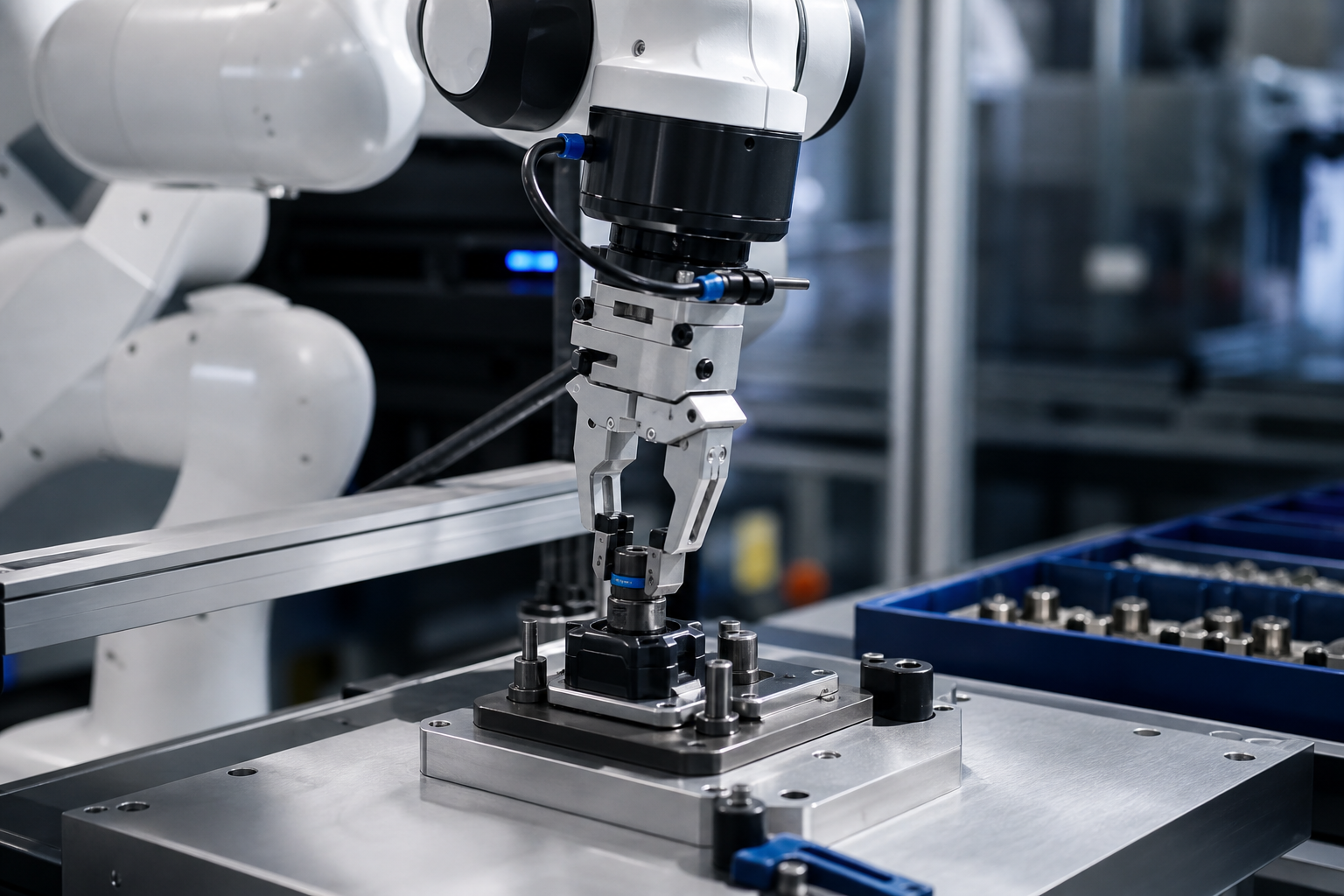
- Manipulators (Franka, Universal Robots) — grasping, insertion, contact-rich assembly. The reward and action space center on end-effector pose and contact forces, because that's where the task lives. These robots run in industrial settings where human proximity triggers hard safety requirements, so the policy is never the whole system — it's the policy plus a safety layer.
- Quadrupeds (Unitree) — locomotion, terrain adaptation, recovery behaviors. This is RL's clearest demonstrated win. Google Research and NVIDIA both showed sim-trained gaits transferring zero-shot to real quadrupeds through domain randomization and injected perturbations, producing trotting and galloping behaviors that classical control struggles to hand-specify. When the contact dynamics are the problem, RL is the answer.
- Humanoids — whole-body control, balance, bimanual manipulation. The highest-dimensional action space of the three, with the tightest coupling between balance and task: every arm motion perturbs the center of mass. This is the hardest current frontier, and the one where reward engineering and observation-space design punish shortcuts most severely.
- Shared deployment constraints — every morphology faces the same three limits. The inference loop must complete within the control period, or the robot destabilizes. The policy runs on on-robot edge compute, not the cloud, so network latency can't be in the loop. And any deployed policy operates inside a safety envelope it does not control.
- Safety envelopes (industrial context) — collaborative robot safety is governed by ISO/TS 15066:2016, which extends ISO 10218-1:2011 and ISO 10218-2:2011 with quantitative limits on allowable contact forces and pressures for each human body region. ISO 10218-1 covers robot design and construction — emergency stops, safeguarding, safety-rated motion control. ISO 10218-2 covers integration of robots into systems and their work environment. Any deployed RL policy in a factory must respect these force and pressure limits as hard constraints layered outside the learned policy. The policy proposes an action; the safety system disposes of anything that would exceed the envelope. Worth flagging: the ScienceDirect review of ISO 15066 notes that validating force limits is complex and that conservative thresholds can constrain productivity — so the safety envelope is a real engineering cost, not a checkbox.
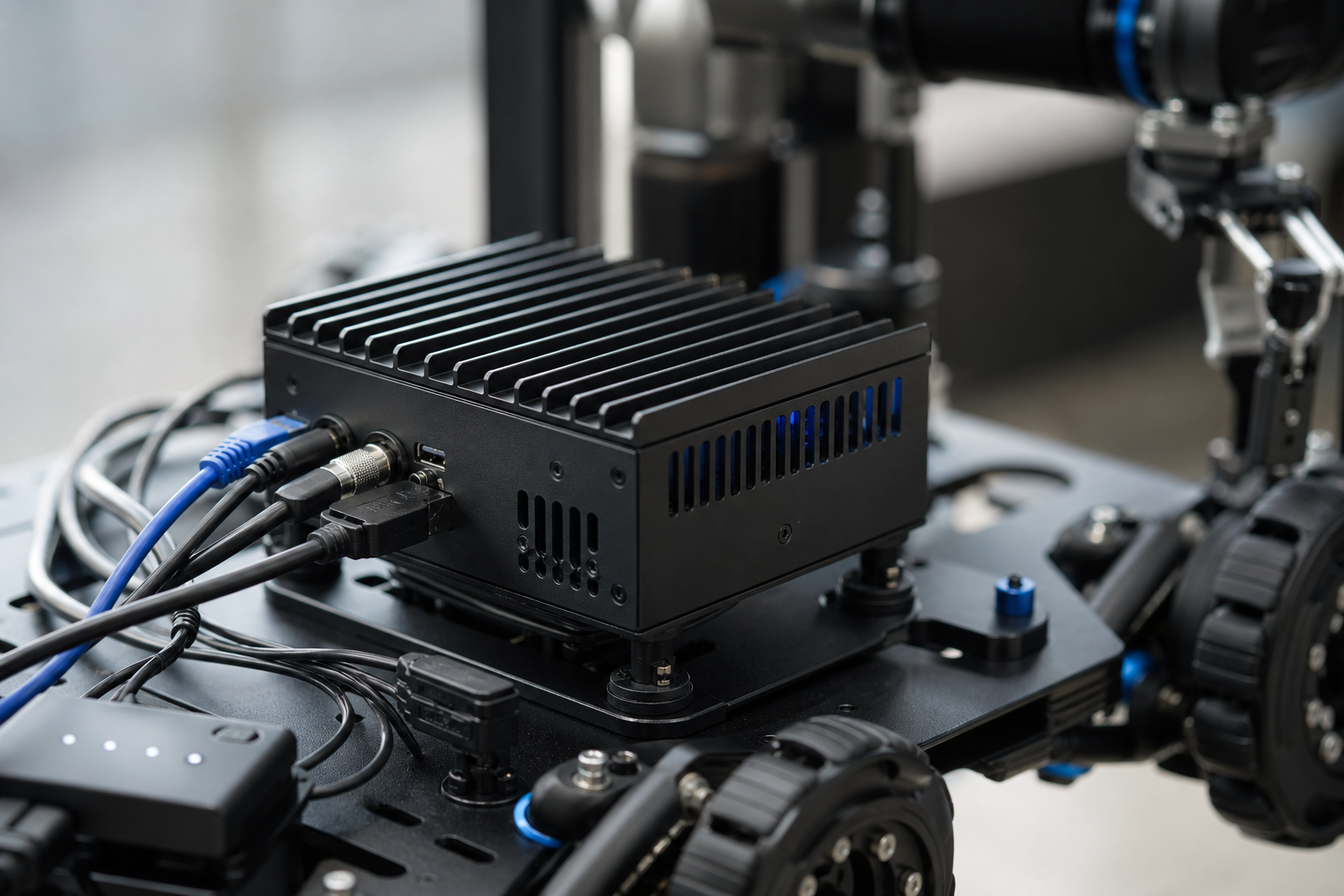
The pattern across all three morphologies: the learned policy is one component in a stack. Sensors feed it, edge compute runs it, and a safety system bounds it. The more capable your policy, the more disciplined that surrounding stack has to be.
RL Readiness Checklist: Is Your Task Deployment-Ready?
Run your project against these seven checks before you commit compute and calendar. Each one has a clear yes/no consequence.
- Is the task contact-rich, dynamic, or hard-to-model? If yes, a reinforcement learning robot policy is a genuine fit. If it's fixed-geometry and repeatable, a scripted or classical-control solution is cheaper to build and far easier to certify. Don't reach for RL because it's interesting.
- Can you define a reward — or provide demonstrations? No usable reward signal and no demonstrations means no RL, full stop. If you have demonstrations but a reward that's genuinely hard to specify, plan for RL + imitation rather than pure RL.
- Do you have an accurate environment model or scan for simulation? Sim-to-real transfer degrades when the simulator doesn't cover reality. A real-to-sim scan of the actual deployment site tightens the gap before you spend a single GPU-hour on training.
- Have you scoped your domain randomization ranges? Ranges too narrow produce brittle transfer; too wide produce a mediocre conservative average. Budget explicit iteration time to tune them against measured sim-real discrepancy — this is not a set-and-forget parameter.
- Is your target hardware supported and edge-deploy capable? Confirm the policy can complete its inference loop within the control frequency on your on-robot compute, Jetson-class or equivalent. Cloud-only inference with network latency in the control loop is not a deployment.
- Do you have an evaluation harness you actually trust? "Works in sim" is not deployment-ready. You need held-out randomized evaluation plus real-hardware validation before you scale beyond one robot.
- For industrial deployment: do you meet ISO 10218 / ISO/TS 15066 safety limits? Force and pressure limits are hard constraints layered outside the learned policy. Validate the safety envelope independently of policy performance — a policy that scores well and violates contact limits is not deployable.
The forward move is concrete: capture your deployment environment and run one policy end-to-end — scan, train, deploy, validate — before you scale to a fleet. The teams that succeed prove the full pipeline on a single skill first, then replicate. The ones that stall try to solve every task at once and never close the loop on one.
Reinforcement Learning for Robots: Frequently Asked Questions
How long does it take to train an RL policy for a robot?
It ranges widely by task and method. Massively parallel simulation training — thousands of environment instances running at once — compresses what would otherwise be months of real-world data collection. NVIDIA's Spot locomotion workflow reached real-world-ready gaits entirely in simulation, with no real-world training at all. The dominant driver isn't the algorithm; it's whether you train in parallel simulation or collect data on physical hardware. The EPFL JetBot work flagged real-world collection as expensive and slow, which is exactly why simulation-first training became standard.
Do I need a machine learning team to deploy RL on robots?
Not necessarily. From-scratch RL demands genuine expertise in reward engineering, simulation setup, and sim-to-real tuning — the parts that consume months. Pretrained-policy and managed-pipeline approaches remove most of that loop, letting teams deploy working skills without in-house ML PhDs. The tradeoff, covered in the buy-build-fine-tune comparison above, is control for speed: you inherit someone else's tuning instead of doing your own.
What's the difference between reinforcement learning and imitation learning for robots?
RL learns from a reward signal through trial and error. Imitation learning learns from expert demonstrations without any reward function. The sim-to-real method survey lists both as complementary families rather than competitors — demonstrations bootstrap early exploration, and reward refines the behavior afterward. That's why RL + imitation is common for contact-rich tasks where pure exploration would take forever to stumble onto success and pure imitation can't generalize past the demonstrations.
Can one RL policy transfer between different robots?
Rarely without change. A policy is tied to a specific observation space and action space, so a policy trained on a Unitree quadruped won't run on a Franka arm — different sensors, different actuators, different everything. Morphology changes require retraining or substantial fine-tuning. The deployable artifact is the trained weights for one embodiment, and those weights encode assumptions about the body they learned on.
Is RL safe to run on real hardware?
Only with independent guardrails. Untrained policies flail, which is the whole reason training happens in simulation rather than on the physical robot. Once deployed, industrial systems must satisfy ISO/TS 15066 contact-force and pressure limits, and that safety envelope sits outside the learned policy — validated separately, enforced by a safety system that overrides any action exceeding the limits. The policy proposes; the safety layer has final say.