
The 15 Best Robotics Books for Engineers and Beginners in 2026
The 15 Best Robotics Books for Engineers and Beginners in 2026
You have more ways to learn robotics in 2026 than any cohort before you — Coursera specializations, MIT OpenCourseWare, Hugging Face LeRobot demos, ICRA paper firehoses, and a ROS 2 Jazzy documentation tree that updates faster than any textbook can. So why does a 700-page hardcover still earn shelf space next to your Jetson Orin dev kit? Because the right robotics books still do one thing better than every other format: they enforce a sequence. Kinematics before dynamics, dynamics before control, control before planning. A YouTube playlist cannot make you respect that order. A textbook can.
This list is the working stack of an engineer shipping in 2026 — half theory that ages slowly, half deployment manuals that age fast, all chosen with the awareness that you will live with these choices for the next three projects.
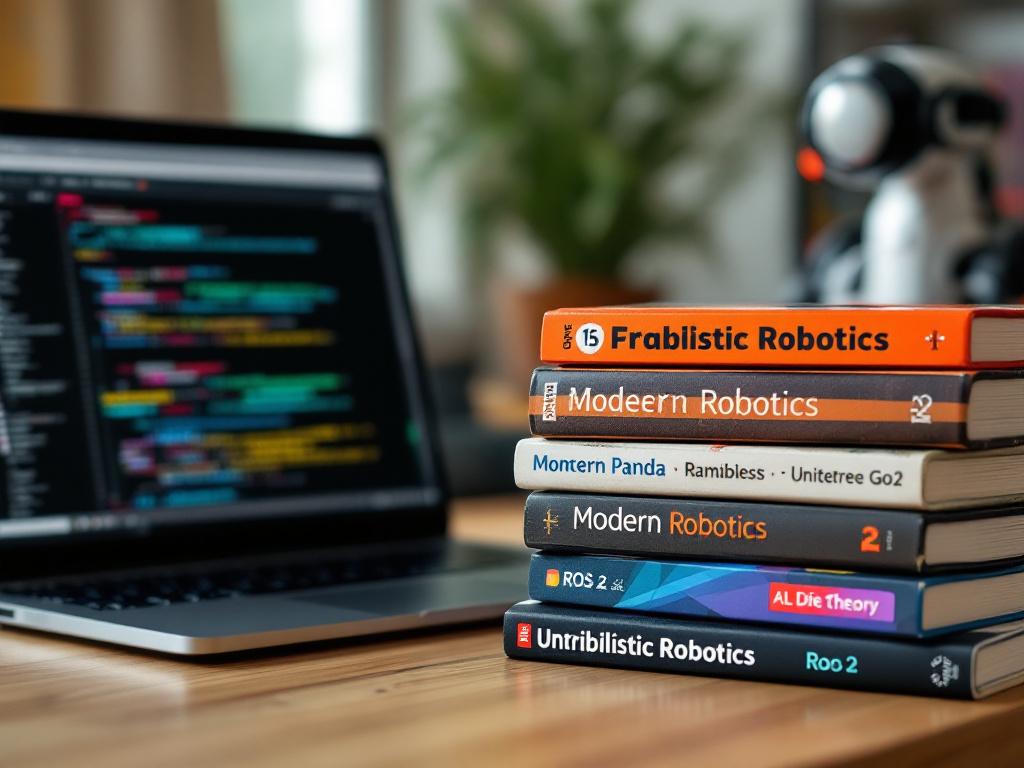
Table of Contents
- Why Your Robotics Reading List Determines Your Project Velocity
- Match the Book to Your Role Before You Spend a Dollar
- The 15 Best Robotics Books for 2026, Ranked by Practical Impact
- Read Robotics Books Like Reference Manuals, Not Novels
- The Skill-Gap Triage Guide — Which Book Solves Which Problem
- Five Reading Mistakes That Quietly Kill Robotics Projects
- Build Your 2026 Robotics Reading Stack — A Six-Step Action Plan
- Frequently Asked Questions
Why Your Robotics Reading List Determines Your Project Velocity
A robotics engineer in 2026 has more learning options than at any point in the field's history. So the question is fair: with ROS 2 Jazzy tutorials, MIT OpenCourseWare lectures, and a Hugging Face model card published every 11 minutes, why open a 700-page textbook at all?
Because of what books still do better than any other format: sustained narrative across a discipline. Modern Robotics by Kevin Lynch and Frank Park walks you from configuration space through forward kinematics, velocity kinematics, dynamics, trajectory generation, and motion planning as a single logical sequence — with the same notation throughout. According to Kevin Lynch's course page at Northwestern, the book is paired with full lecture videos and lab software, all free. A YouTube playlist cannot enforce that sequence. A textbook can, and it does.
What books do worse than other formats: current toolchain syntax. A book printed in 2022 already shows deprecated ROS 2 launch file syntax, MuJoCo APIs from before MJX parallelization, and Isaac Sim 3.x calls that no longer exist. For anything where the keystrokes matter, the official ROS 2 documentation is the only source of truth. The book layer is for concepts; the docs layer is for commands.
This is the hybrid reality of robotics learning in 2026. Theory ages slowly — the kinematics John Craig wrote in 1986 is still correct. APIs age fast: ROS 1 reached end-of-life in May 2025 according to the ROS 2 release roadmap. Books are for the slow-moving layer. Treat them that way and they pay back; treat them as deployment manuals and you waste both time and money.
The cost of choosing the wrong book is measured in time, not dollars. A founder building a pick-and-place demo who reads Probabilistic Robotics (Thrun, Burgard, Fox) front-to-back has spent 50+ hours on SLAM theory the project will never deploy. The same founder reading the relevant 80 pages of Modern Robotics on screw theory and product-of-exponentials, plus the Franka FCI documentation, ships in three weeks instead of three months. The books did not fail. The reading order did.
This matters more in 2026 than it did five years ago because the deployable layer of robotics has moved. Teams running pretrained reinforcement learning policies through real-to-sim pipelines onto edge hardware like NVIDIA Jetson Orin platforms need to understand what the policy is doing — the dynamics, the contact model, the reward shaping — without re-deriving any of it. Books become the conceptual bridge between black-box deployment and debuggable behavior. You cannot fix what you cannot see, and you cannot see what you have not read about.
Books are the slow-moving infrastructure of a robotics career. Choose them like you'd choose a database — once, deliberately, and with awareness that you'll live with the consequences.
The rest of this guide treats your reading list with that weight. Section 2 maps your role to the depth and time budget you can realistically commit. Section 3 ranks the 15 robotics books that earn shelf space in 2026. Section 5 turns the list into a triage tool: which chapter solves the problem you are hitting today.
Match the Book to Your Role Before You Spend a Dollar
The single most expensive mistake in robotics learning is reading the right book in the wrong order — or buying a manipulator-focused text when you ship legged locomotion. The matrix below is a triage tool, not a prescription. The time-window estimates are practical reading ranges we have observed across teams, not sourced statistics. Your mileage will vary with your math background and how much you pair reading with code.
| Reader Profile | Reading Depth | Math Rigor | Deployment Focus | Reading Window |
|---|---|---|---|---|
| RL / Humanoid Engineer | Sequential, deep | High (Lie groups, MDPs) | Medium | 40–60 hrs |
| Manipulator Integrator | Selective, deep on key chapters | Medium (control, planning) | High | 20–40 hrs |
| Robotics Startup Founder | Triage-driven, fast | Low–medium (system-level) | Very high | 10–20 hrs |
| Academic / ROS 2 Maker | Project-driven | Low–medium | High (sim + hardware) | 20–35 hrs |
| Fleet Ops / SRE | Strategic skim | Low | Medium (failure modes) | 5–15 hrs |
Three things the table does not make obvious are worth stating directly.
Reading order matters more than book selection within a role. A founder who reads Hands-On ROS 2 before Modern Robotics will deploy faster than the same founder reading them in reverse, because the founder's project gives the theory book a target. Theory absorbed without a project is theory forgotten. This is observational, not research-backed — but it is consistent across every shipping team we have worked with.
Math rigor is asymmetric across roles. An RL engineer who cannot manipulate Lie group notation is blocked at chapter 3 of any modern robotics text. A fleet operations manager who cannot read a transformation matrix can still ship — they are optimizing uptime and failure modes, not deriving controllers. Robotics books for beginners often pitch a single math threshold for the whole field. There is no such threshold. There is only the math your role actually uses.
The deployment-focus column is where 2026 differs from 2016. Five years ago, "deploy" meant getting code onto a single robot. Today, deployment includes sim-to-real transfer, domain randomization, and edge inference on hardware like the NVIDIA Jetson Orin family. Robotics engineering books written before 2020 largely ignore this layer. Supplement them with current platform documentation — the ROS 2 Jazzy docs, NVIDIA Isaac Lab tutorials, and deployment guides from real-to-sim platforms such as OpenKinematics.
With your profile mapped, here are the 15 books that earn shelf space in 2026.
The 15 Best Robotics Books for 2026, Ranked by Practical Impact
Four criteria shaped this ranking: currency of toolchain references, durability of the underlying theory, practitioner adoption signals (course syllabi at CMU, MIT, Berkeley, ETH Zürich, GitHub README citations, ICRA and IROS pedagogical references), and availability of free or open-access editions.
The list intentionally mixes 1980s classics whose math still loads, 2010s canonical references that defined the modern field, and 2022–2024 toolchain books that target ROS 2 natively. Books published before 2000 are excluded unless their theory is still load-bearing — which is why Murray, Li, and Sastry (1994) makes the cut and very little else from that decade does.
A note on free editions: five of the most-cited robotics books in graduate syllabi worldwide are free PDFs hosted by their authors or course pages. This is not a piracy notice — it is the publishing reality of academic robotics. Authors host PDFs because the citation count from open access exceeds the royalty income from a $90 hardcover. Start with the free tier. Buy print only for the books you will mark up.
1. Modern Robotics: Mechanics, Planning, and Control — Lynch & Park, 2017
Best for: Humanoid and RL engineers, academics, manipulator depth
Free version: Yes — full PDF and lecture videos at hades.mech.northwestern.edu
The most influential robotics textbook of the last decade. The screw theory and product-of-exponentials formulation make Lie group concepts tractable in a way no prior text managed. Chapters 8 through 11 on dynamics and control are the cleanest treatment in print. Caveat: light on perception — pair with Szeliski or Corke if your role touches vision.
2. Robotics: Modelling, Planning and Control — Siciliano, Sciavicco, Villani, Oriolo, 2009
Best for: Manipulator integrators, academic depth
Free version: No — Springer page
Chapters 7 through 9 on differential kinematics and statics remain the clearest treatment in print, and the book is still required reading in many European robotics programs. Caveat: the ROS examples are firmly ROS 1-era. Read it for the math; ignore the toolchain references entirely.
3. Probabilistic Robotics — Thrun, Burgard, Fox, 2005
Best for: SLAM, localization, mobile robots
Free version: No — MIT Press
Still the canonical derivation of the Bayes filter, particle filter, and EKF SLAM. Twenty years on, no replacement has displaced it. Caveat: it predates deep learning entirely. Pair the book's foundations with current learned-SLAM work and the ORB-SLAM3 or OpenVINS repositories on GitHub.
4. Planning Algorithms — Steven M. LaValle, 2006
Best for: Motion planning, sampling-based methods
Free version: Yes — full HTML and PDF at lavalle.pl/planning
The definitive treatment of RRT, PRM, and configuration space. Dense — read it chapter-by-chapter as a reference, not cover-to-cover. If you are debugging an RRT* convergence problem at 2 a.m., chapter 5 or 6 has your answer.
5. Introduction to Autonomous Mobile Robots — Siegwart, Nourbakhsh, Scaramuzza, 2nd ed., 2011
Best for: Mobile robotics, makers, ROS 2 learners
Free version: No — MIT Press
The clearest single-volume treatment of locomotion, perception, and localization for wheeled mobile robots. Caveat: a 2011 sensor suite — no modern solid-state LiDAR, no current visual-inertial systems. The frameworks survive; the hardware references do not.
6. Reinforcement Learning: An Introduction — Sutton & Barto, 2nd ed., 2018
Best for: RL practitioners building robotics-adjacent foundations
Free version: Yes — author's PDF
The only book that builds RL intuition from bandits to policy gradients without skipping. Chapter 13 on policy gradient methods is essential before you read any robot RL paper. Caveat: not robotics-specific. You will still need a current paper diet on top of it.
7. Robotics, Vision and Control: Fundamental Algorithms in Python — Peter Corke, 3rd ed., 2023
Best for: Hands-on engineers spanning manipulation and vision
Free version: No, but the Robotics Toolbox is open-source on GitHub
Every concept is paired with runnable Python. Chapter 15 on visual servoing is the cleanest treatment with code anywhere. Caveat: older editions carry MATLAB legacy — use the 3rd edition, not earlier.

8. Hands-On ROS 2 for Robotics Development — Aditya Kamath, 2022
Best for: ROS 2 onboarding, startup engineers
Free version: No — Packt
Deployment-focused. You have a working node up by chapter 2, and the book trades theoretical completeness for shipping speed. Caveat: written against ROS 2 Humble. Verify every command against the current Jazzy docs before you copy-paste.
9. A Mathematical Introduction to Robotic Manipulation — Murray, Li, Sastry, 1994
Best for: Rigorous manipulation theory, academics
Free version: Yes — full PDF at Caltech
The foundational treatment of grasping, contact mechanics, and the geometric formulation of manipulation. Caveat: 1994 notation is heavier than modern texts. Read this after Lynch & Park, not before — Lynch's notation is the on-ramp.
10. Introduction to Robotics: Mechanics and Control — John J. Craig, 4th ed., 2017
Best for: Industrial integrators, undergraduate-level entry
Free version: No
The gentlest curve into Denavit-Hartenberg parameters and trajectory generation. If you are onboarding a mechanical engineer to robotics and the math jump is steep, this is the right starting point. Caveat: a gentler curve means less depth — you will outgrow it within a year, but you will have a foundation to outgrow.
11. Springer Handbook of Robotics — Siciliano & Khatib (eds.), 2nd ed., 2016
Best for: Reference shelf for any role
Free version: No — Springer
More than 80 chapters by domain experts. The field's encyclopedia. Caveat: do not read it cover-to-cover — it is 2,300 pages, and a startup founder who attempts it has burned a quarter. Use it as a lookup. Section 5 of this guide will tell you which chapters to open first.
12. Computer Vision: Algorithms and Applications — Richard Szeliski, 2nd ed., 2022
Best for: Perception engineers
Free version: Yes — author's draft at szeliski.org/Book
The 2022 edition adds substantive deep-learning sections and bridges classical and learned vision more cleanly than any competitor. Caveat: vision-centric, not robotics-centric. Pair with Corke chapter 15 if visual servoing is your target.
13. Robot Operating System (ROS): The Complete Reference, Vol. 5 — Anis Koubaa (ed.), 2021
Best for: ROS 2 deep architecture (DDS, lifecycle nodes, real-time executors)
Free version: No — Springer
Volumes 4 and 5 are the ROS 2 volumes. Read them after you have shipped a working node, not before. Caveat: edited collections have uneven chapter quality — skim the table of contents and pick the three chapters that match your architecture.
14. Underactuated Robotics — Russ Tedrake, MIT (ongoing)
Best for: Legged robots, humanoids, optimization-based control
Free version: Yes — full course notes and lecture videos at underactuated.mit.edu
The most current treatment of trajectory optimization, LQR, and MPC for legged and humanoid systems. Updated yearly, which is closer to the field's actual pace than any printed textbook. Caveat: course-notes form, not a polished reading experience — but the freshness matters more than the polish.
15. Probabilistic Machine Learning: An Introduction — Kevin Murphy, 2022
Best for: RL and learned-perception engineers needing ML grounding
Free version: Yes — author's PDF at probml.github.io
The most current ML reference with robotics-relevant chapters on graphical models, variational inference, and Gaussian processes. Caveat: not robotics-specific. Use selectively — chapters 3, 8, and 17 are the highest-leverage entries for a robotics engineer.
Free does not mean inferior. Five of the most-cited robotics books in graduate syllabi worldwide are free PDFs hosted by their authors — start there before you open your wallet.
Read Robotics Books Like Reference Manuals, Not Novels
Most engineers attempt to read robotics books linearly, drop off at chapter 4, and conclude books do not work for them. The books worked. The workflow did not. The seven items below are the workflow that does.
1. Pick exactly one anchor book. Use the matrix from Section 2. Commit to reading it front-to-back over five to eight weeks at 30–45 minutes a day. Everything else is a skim shelf. The anchor is what you will know cold; the skim shelf is what you will know how to find.
2. Pair every theory chapter with code in the same week. If you read chapter 5 of Modern Robotics on velocity kinematics, implement the Jacobian for a 6-DOF arm in PyBullet, MuJoCo, or NVIDIA Isaac Sim before chapter 6. Reading without implementation is a memory exercise. Reading with implementation is a skill exercise. The two produce different engineers.
3. Skim the table of contents and one chapter intro before buying. Many "essential" books cover roughly 30% of what your role needs. The free PDF tier — LaValle, Sutton & Barto, Lynch & Park, Tedrake, Murphy, Szeliski — lets you pre-screen without committing. Open the PDF, read 20 pages, decide.
4. Build a reference shelf, not a reading queue. Three books open on your desk; the rest live in a deep-dive-when-needed pile. Robotics is non-sequential — you reference, you do not re-read. The handbook on the shelf you opened twice this quarter is doing more work than the reading queue you are guilt-tripping yourself about.
5. Cross-check every toolchain reference against current docs. Any book published before 2024 will have stale ROS 2 commands, deprecated Isaac Sim APIs, or pre-MJX MuJoCo examples. The conceptual content stays valid; the code does not. Verify against the Jazzy documentation before you spend an afternoon debugging a deprecated launch file.
6. Apply a 10-year shelf life to anything practical, lifetime to anything mathematical. Kinematics from Craig (1986) is correct. ROS examples from Craig are not. Treat the math as durable; treat the code as expired the day it was printed. This is the single rule that separates engineers who use old books well from engineers who get burned by them.
7. Form or join a 2–4 person reading group if your team allows it. A biweekly 30-minute sync where each person presents one chapter section forces comprehension and surfaces blind spots. This is observational practitioner advice, not research — but every team we have seen run it has reported the same outcome: the group catches what the individual misses, especially in dense math chapters.
The Skill-Gap Triage Guide — Which Book Solves Which Problem
You know your role. Now you have a problem. The categories below map symptoms to the specific chapter or chapter range that addresses them. The goal is not to re-list the 15 books — it is to give you a lookup for the bug, blocker, or knowledge gap you are hitting this week.
Motion Planning and Collision Avoidance. Start with LaValle's Planning Algorithms, chapters 5 through 7 — sampling-based planners, RRT variants, and configuration space basics. Free at lavalle.pl/planning. If you are debugging RRT* convergence specifically in cluttered scenes, supplement with Probabilistic Robotics chapter 25 on motion planning under uncertainty. The two together cover roughly 90% of the planning problems shipping teams encounter.
SLAM and Localization. Probabilistic Robotics remains the canonical reference for EKF SLAM, FastSLAM, and graph-based SLAM derivations — chapters 10 through 13. For learned SLAM and visual-inertial odometry on current hardware, the book layer falls short of the field. Supplement with the ORB-SLAM3 or OpenVINS GitHub documentation, and read recent VIO papers from ICRA 2024 onward.
Manipulator Kinematics and Control. Lynch & Park's Modern Robotics, chapters 4 through 6 for forward and inverse kinematics via screw theory, then chapters 8 through 11 for dynamics and control. For industrial trajectory generation specifically, Craig's chapter 7 is more direct and ships in less time. Use Lynch for depth, Craig for speed.
Reinforcement Learning for Legged Locomotion. Sutton & Barto for foundations — chapter 13 on policy gradients is non-negotiable. Tedrake's Underactuated Robotics (free at underactuated.mit.edu) for the optimization-based control side. Robotics learning books alone are insufficient for sim-to-real RL — pair with NVIDIA Isaac Lab tutorials and the Tobin et al. domain randomization paper at arXiv:1703.06907.
Perception and Visual Servoing. Szeliski's Computer Vision 2nd edition (free draft at szeliski.org/Book) for classical and learned vision. For visual servoing specifically — image-based, position-based, and hybrid — Corke's Robotics, Vision and Control chapter 15 is the cleanest treatment with runnable Python.
ROS 2 Architecture and Deployment. Kamath's Hands-On ROS 2 for getting nodes running fast. Koubaa's Complete Reference Vol. 5 for deeper architectural patterns — DDS quality of service, lifecycle node design, real-time executors. Always cross-check against the Jazzy docs, because the books lag the active distribution by 12 to 18 months on average.
One category has no definitive book yet in 2026: sim-to-real transfer for RL policies on production hardware. Practitioners deploying real-to-sim LiDAR pipelines — the kind of workflow OpenKinematics packages on Jetson Orin — are still working from papers, platform docs, and engineering blog posts, not from textbooks. This is a genuine gap in the field's literature, and it will close eventually. It has not closed yet.
Five Reading Mistakes That Quietly Kill Robotics Projects
The five mistakes below are the ones that cost teams months without ever announcing themselves as mistakes. Each is named, illustrated with a role-specific example, and given an exit.
Mistake 1: Starting with a 2005 classic before opening current docs. Probabilistic Robotics is a masterpiece, but if you are building a SLAM stack on a Jetson Orin in 2026, you need ROS 2 Nav2 and a current visual-inertial library running before you crack chapter 1. The book gives you why the math works; the docs give you what to type. Wrong order produces three weeks of confusion that resolve the moment the docs come first. Exit: install the toolchain, get a hello-world node running, then open the textbook.
Mistake 2: Reading without target hardware. Reading Modern Robotics without access to a 6-DOF arm — real, in MuJoCo, or in Isaac Sim — is reading about swimming. The chapters on inverse kinematics make sense only when you have a robot that can fail to reach a pose. Set up the simulator before chapter 2. The simulator is not a supplement to the book; it is the second half of the book.
Mistake 3: Confusing comprehensive with appropriate. The Springer Handbook of Robotics is more than 2,200 pages. A startup founder who reads it cover-to-cover has burned a quarter of a year for a coverage profile that does not match the founder's actual product. Use the handbook as a lookup, not a curriculum. Section 2's matrix exists precisely to prevent this trap.
Mistake 4: Ignoring the free tier. Five of the most-respected texts in the field are free PDFs hosted by their authors: LaValle's Planning Algorithms, Sutton & Barto's Reinforcement Learning, Lynch & Park's Modern Robotics, Tedrake's Underactuated Robotics, and Murphy's Probabilistic Machine Learning. Engineers buy paid robotics books before exhausting these. They should not. Exit: download the free five tonight, evaluate fit, then spend money on what those five do not cover.
Mistake 5: Waiting for the perfect book before starting. No 2026 book covers humanoid locomotion, RL, sim-to-real transfer, and Jetson edge deployment in one volume — and none will, because the field moves faster than the publication cycle. Stitch your stack from three or four books, the relevant arXiv papers, and current platform documentation. Start incomplete. The alternative is not starting, and not starting is the most expensive choice on the menu.
The robotics book that saves you three months of debugging is the one you read in parallel with your first real-hardware run — not the one preserved in shrink-wrap on your desk for a project you will start tomorrow.
Build Your 2026 Robotics Reading Stack — A Six-Step Action Plan
This is not a recap. It is the executable plan you use tonight.

Step 1: Mark your role (60 seconds)
- I am building humanoid or legged locomotion (RL + dynamics)
- I am integrating manipulators or grippers in industrial settings
- I am a robotics startup founder shipping a first product
- I am an academic or maker building on ROS 2
- I am operating a fleet — warehouse, logistics, or service robotics
- I am working with: Unitree / Franka / Universal Robots / NVIDIA Jetson / other ___
Step 2: Pick exactly one anchor book
The anchor is the book you will read front-to-back. Pick by role:
- Humanoid or legged → Modern Robotics (Lynch & Park) plus Tedrake's Underactuated Robotics notes
- Manipulator integrator → Craig's Introduction to Robotics for the on-ramp; Siciliano et al. for depth
- Startup founder → Kamath's Hands-On ROS 2 paired with targeted chapters of Modern Robotics
- Academic or maker → Corke's Robotics, Vision and Control (3rd edition, Python)
- Fleet operations → Siegwart, Nourbakhsh, Scaramuzza's Introduction to Autonomous Mobile Robots
If this is your first robotics book — robotics books for beginners is the search you ran to find this article — Craig or Corke are the gentler entries. Lynch & Park is the right anchor only if you are comfortable with linear algebra and willing to commit eight weeks.
Step 3: Add 2–3 skim-shelf books
Pull these from Section 5's triage guide, based on the actual problem your next 90-day project will hit. Not what might come up. What will come up. If the project is SLAM, add Probabilistic Robotics and bookmark chapters 10–13. If the project is RL, add Sutton & Barto and bookmark chapter 13.
Step 4: Set up your simulator before chapter 1
Install MuJoCo, NVIDIA Isaac Sim, or Gazebo — whichever matches your hardware target. The book is useless without something to run code against, and standing the simulator up first removes the highest-friction barrier between you and chapter 2 implementation.
Step 5: Schedule the time honestly
- Anchor book: 45 min/day × 5 days/week × 6–8 weeks
- Skim shelf: 15 min/day on relevant chapters only
- Implementation pairing: roughly 2–3 hours/week minimum in your simulator
- If you cannot commit to this, halve the stack. Better to finish two books than abandon five.
Step 6: Track your stack
| Book | Role | Free? | Status | Target Chapter This Week |
|---|---|---|---|---|
| [Anchor] | Reading | Ch. ___ | ||
| [Skim 1] | Queued | |||
| [Skim 2] | Queued | |||
| [Skim 3] | Queued |
Pick your anchor before you close this tab. If it is free, download the PDF now. If it is not, order it tonight. Open chapter 1 this week and write working code against chapter 2 before next weekend. Robotics literature rewards the engineer who starts a flawed stack on Monday over the one assembling a perfect stack indefinitely. Your reading list compounds — but only if you start it.
Frequently Asked Questions
Should I buy physical books or use digital editions?
Digital for skim-shelf reference — searchable, portable, accessible during simulator debugging. Physical for the anchor book if you retain better with paper and marginalia. For the free PDFs (LaValle, Sutton & Barto, Tedrake, Lynch & Park, Murphy, Szeliski), digital is the only edition the authors offer. A reasonable compromise: physical anchor, digital skim shelf. Personal preference, not research.
Can I just read papers and skip books?
Papers assume the context books build. A 2024 sim-to-real RL paper assumes you already understand MDPs, policy gradients, and contact dynamics — concepts a textbook builds in 200 pages. If you have the foundation, papers are faster. If you do not, papers will read as noise. Books are the on-ramp; papers are the highway. You need both, in that order.
Are there robotics books specific to Unitree, Franka, or Universal Robots?
No, and there should not be. Books teach principles; vendor SDKs teach APIs that change every quarter. Use the manufacturer's documentation — Franka FCI, Unitree SDK, URScript reference — for hardware specifics, and books for the underlying kinematics, control, and planning. Mixing the two layers correctly is the skill the Section 4 workflow builds.
Should I read any ROS 1 books in 2026?
No. ROS 1 reached end-of-life in May 2025, per the ROS 2 release roadmap. Pre-2021 ROS books are net-negative for new engineers — you will spend reading time on deprecated patterns. Start ROS 2-native with Kamath (2022) or Koubaa Vol. 5 (2021), and verify everything against the current Jazzy docs.
Is there a single book covering sim-to-real transfer for RL policies?
Not yet. The field moves faster than the publication cycle. The closest practical resources are Tedrake's Underactuated Robotics notes (updated yearly), Tobin et al.'s domain randomization paper at arXiv:1703.06907, and platform documentation from teams shipping real-to-sim pipelines. For now, this is a paper-and-docs domain, not a textbook one — and the engineers shipping in this space are reading accordingly.