Robotics Foundation Models: The 2026 Guide to Pretrained Policies for Real Robots
Why Pretrained Policies Beat Custom RL Training in 2026
Your Franka Panda has been on the bench for four months. The internal RL training run keeps converging on the same local optimum, the gripper still fumbles novel SKUs, and yesterday a competitor announced they shipped a similar manipulator skill in under eight weeks — fine-tuned from a pretrained Vision-Language-Action (VLA) policy on roughly 150 expert trajectories. Your CEO wants to know why. The honest answer is not budget, headcount, or silicon. It is whether your team started with learned priors — a robotics foundation model — or started from zero.
That gap is structural. According to Sergey Levine of UC Berkeley, foundation model initialization is "an essential component to getting the generalization that we want" (AI for Good). Without broad pretraining, narrowly trained policies have no prior over recovery behavior when the environment shifts even slightly outside their training distribution. With it, you get policies that match the performance of environment-specific training while generalizing beyond it.
This guide delivers a working definition of robotics foundation models, a head-to-head against custom RL, a six-criteria evaluation framework, the sim-to-real reality check most teams underestimate, morphology-specific deployment patterns, and a four-phase adoption checklist you can walk into your next standup.
Table of Contents
- Why Pretrained Policies Beat Custom RL Training in 2026
- Foundation Models vs. Custom RL — A Head-to-Head Decision Matrix
- The Six-Criteria Evaluation Framework for Robotics Foundation Models
- Real-to-Sim Pipelines — Why Environment Capture Decides Deployment Success
- Morphology-Specific Deployment Patterns
- Your Foundation Model Adoption Checklist
A 2026 survey defines robotics foundation models as large-scale ML models that serve as versatile building blocks for a wide array of robotics tasks, trained on diverse multi-task, multi-embodiment datasets and adapted via fine-tuning (National AI Research Lab; arXiv review). Investor analyst Scale Venture Partners — a vendor-aligned source whose framing should be read accordingly — describes them as a middleware layer between hardware and application-specific software, analogous to LLMs but spanning navigation, manipulation, and perception (Scale Venture Partners).
The training recipe mirrors LLM development in two phases. First, broad pretraining on web data, semantic image-action data, and verbal instruction data. Second, post-training via supervised fine-tuning and reinforcement learning — either RLHF or RL with verifiers (Levine, AI for Good). That second phase is where your team's curated trajectories enter. The first phase is where the open ecosystem — RT-X, Open X-Embodiment, and the proprietary datasets behind commercial VLAs — does work your team should never attempt to replicate from scratch.
Here is the central empirical claim, drawn directly from Levine's experimental work: policies initialized from a robotic foundation model can match the performance of policies trained directly in the target environment, while narrowly trained systems without broad pretraining fail to recover from unusual states at deployment (Levine). His phrasing is worth quoting directly — the broad pretraining data "covers that range of situations and tells the robot how it should recover."
A custom RL policy trained on narrow, high-quality demonstrations has no prior over what to do when the gripper sees an unfamiliar tote, when warehouse LED lighting shifts at sundown, or when surface friction changes after a floor wax. A foundation-model-initialized policy does — because it has seen analogous states across thousands of hours of cross-embodiment data. The narrow policy is brittle by construction. The pretrained policy is brittle only at the edges your fine-tuning data did not cover.
Cross-embodiment evidence reinforces the case. The RT-X and Open X-Embodiment efforts demonstrated that a single policy can control many different robot types by tokenizing actions and training on a shared dataset, enabling zero-shot transfer to new robots (Interconnects AI). That is the empirical foundation of the buy-don't-build argument for 2026: the cross-embodiment work has already been done in the open, and your team's job is to consume it intelligently — not to recreate it.
A pretrained policy is not a silver bullet — it is a starting point that collapses your exploration space from infinite to tractable, and that compression is what makes 8-week deployments possible.
None of this means foundation models eliminate engineering effort. They require the right evaluation criteria, a precise environment capture pipeline, and a morphology that fits the pretraining distribution. The rest of this guide is the decision framework for getting those three things right.
Foundation Models vs. Custom RL — A Head-to-Head Decision Matrix
The choice between a pretrained foundation model and a custom RL pipeline is the single highest-leverage decision in a robotics deployment project. Get it wrong on month one and you are still wrong on month six, with sunk costs that prevent course correction.
| Criterion | Pretrained Foundation Model | Custom-Trained RL Policy |
|---|---|---|
| Time to first working policy | 2–8 weeks (with fine-tuning) | 3–6 months |
| Data required for adaptation | Tens to a few hundred trajectories | Thousands of domain-specific trajectories |
| Cross-embodiment transfer | Demonstrated (RT-X, Open X-Embodiment) | None — coupled to one platform |
| Recovery from out-of-distribution states | Strong (broad pretraining priors) | Weak (narrow data coverage) |
| Team expertise required | Integration + domain knowledge | ML engineering + robotics + RL specialists |
The trajectory-count claim deserves unpacking. The "tens to a few hundred trajectories per new morphology" range is anchored in Levine's finding that broadly pretrained models can onboard entirely new platforms with a "very small amount of data" (Levine). Compare that to the thousands of demonstrations a from-scratch imitation learning pipeline requires, or the millions of simulated rollouts a from-scratch RL approach burns through. The data efficiency gap is one to two orders of magnitude.
The 40,000 robot-years figure is the other side of that coin. Nathan Lambert estimates that training a true trillion-token robotic foundation model would require ~40,000 robot-years of high-quality interaction data at 50 Hz logging (Interconnects AI). This is precisely why most teams should consume foundation models rather than build them — the data barrier is structural, not solvable with more budget. A startup with $50 million in funding still cannot acquire 40,000 robot-years in any reasonable timeframe. A startup that fine-tunes an existing foundation model can be in production in two months.
Custom RL still wins in three scenarios. First, edge-case morphologies absent from any open dataset — exotic actuator topologies, soft robots, underwater vehicles with hydrodynamic constraints unlike anything in RT-X. Second, safety-critical physics regimes such as surgical robotics or aerospace assembly, where every state must be characterized and certified. Third, tasks where the action space is fundamentally different from existing tokenization schemes — high-frequency force control at 1 kHz, for instance, sits awkwardly inside policies designed around lower-frequency action tokens.
Foundation models win decisively for warehouse manipulators, quadruped fleet deployment, multi-task pilots where you cannot afford a separate model per skill, and any scenario where your team does not include dedicated RL researchers. The hybrid play is now the dominant pattern: fine-tune a foundation model on small in-domain datasets, with massive heterogeneous datasets handling base training and compact curated expert trajectories handling adaptation (Levine).
A note on counter-evidence. Lambert flags that one of the four trends underlying RFMs — multi-robot policies, instruction prompting, teleoperation markets, and low-cost robots — has "large uncertainty of success" (Interconnects AI). Vendor-linked enthusiasm from Covariant and Scale Venture Partners should be weighed against the academic caution surfaced in the arXiv survey, which names open challenges in safety, robustness, dataset bias, and reproducibility as not yet solved (arXiv review). The field is directionally correct but not finished.

The Six-Criteria Evaluation Framework for Robotics Foundation Models
Before you talk to a vendor or download a checkpoint, apply this technical due-diligence framework. Six criteria, each with a red-flag indicator. If a vendor cannot answer all six with specifics, treat the model as a research prototype, not a deployment asset.
1. Pretraining dataset scale and diversity. Ask how many robot-hours, across how many tasks, morphologies, and environments. Lambert's ~40,000 robot-years figure is the order-of-magnitude benchmark for what a truly trillion-token model would need; below that, vendors should be transparent about exactly where their dataset sits (Interconnects AI). The composition norm is web data plus semantic image-action data plus verbal instruction data (Levine). Red flag: Models trained primarily on simulation. Pure-sim approaches fail to capture real-world variability — a point made both in the academic survey and, candidly, by vendor Covariant (Covariant, vendor source).
2. Architecture — is it a real VLA? Second-generation VLA models graft a "motor cortex" — a continuous control head — onto an LLM backbone, analogous to how vision-language models graft a visual encoder onto LLMs (Levine). The joint training of perception, language understanding, and motor control is what produces the recovery behavior you are paying for. Red flag: Models that only output discrete waypoints, or that bolt a language interface onto a classical controller without joint training. That is marketing, not architecture.
3. Tokenized action interface for cross-robot use. Verify the model uses tokenized actions. This is what allowed RT-X to control many robots with different action spaces and adapt zero-shot to new embodiments (Interconnects AI). Tokenization also future-proofs your stack — when you add a second robot platform next year, you do not retrain from scratch. Red flag: Action heads hardcoded to one joint configuration.
4. Sim-to-real evaluation transparency. Has the vendor published sim-to-real transfer metrics on real hardware? Both the NAIRL overview and the arXiv 2026 survey name sim-to-real as a core evaluation dimension whose performance depends on both pretraining data and simulation fidelity. Red flag: Only simulation benchmarks, no real-hardware results. A 95% success rate in NVIDIA Isaac Sim tells you almost nothing about what happens when the policy meets a real gripper, real lighting, and real friction.
5. Deployment footprint and inference latency. Can the model run on your edge hardware — a Jetson Orin Nano, an industrial T4000, an AGX Orin? What is the inference latency at your control frequency? For instruction-prompted control, now a standard interface, your stack must ingest language prompts plus visual observations and output low-latency continuous controls (Interconnects AI). Red flag: Models requiring datacenter GPUs for inference. Your robot fleet does not get to call out to an A100 at 30 Hz.
6. Fine-tuning data requirements and licensing. How many expert trajectories does the vendor recommend per new task and per new morphology? Is the model open-source, source-available, or fully proprietary? Is commercial use permitted at fleet scale, and under what royalty structure? Red flag: Vague answers on trajectory counts, or restrictive licenses that prevent the deployment topology you actually need. Read the license before you write the integration code, not after.
Real-to-Sim Pipelines — Why Environment Capture Decides Deployment Success
The team that fine-tunes a 7B-parameter foundation model in a poorly calibrated simulator will lose to the team that fine-tunes a 1B-parameter model in a precisely scanned environment. Model size has diminishing returns. Environment fidelity does not.
The academic consensus is explicit on this. Both the NAIRL overview and the 2026 arXiv survey name sim-to-real transfer as a core evaluation dimension, with performance depending on both pretraining data and the fidelity of simulation environments used during fine-tuning (NAIRL; arXiv review). Fidelity is not vague — it has three components in practice. Geometry accuracy covers mesh resolution and joint kinematics. Physics calibration covers friction coefficients, mass distribution, and contact dynamics. Sensor models cover camera intrinsics, LiDAR noise profiles, and IMU drift.
When the simulator is inaccurate, the fine-tuned policy learns simulator artifacts — wrong contact dynamics, wrong friction, wrong specular highlights — and these artifacts do not exist in the real world. The policy then fails at deployment, and the team blames the foundation model. The actual failure was environment capture. This is the most expensive misattribution in robotics engineering.
A pretrained policy is only as good as the simulated environment it fine-tunes in. Garbage environment capture guarantees garbage deployment, regardless of how many parameters the foundation model has.
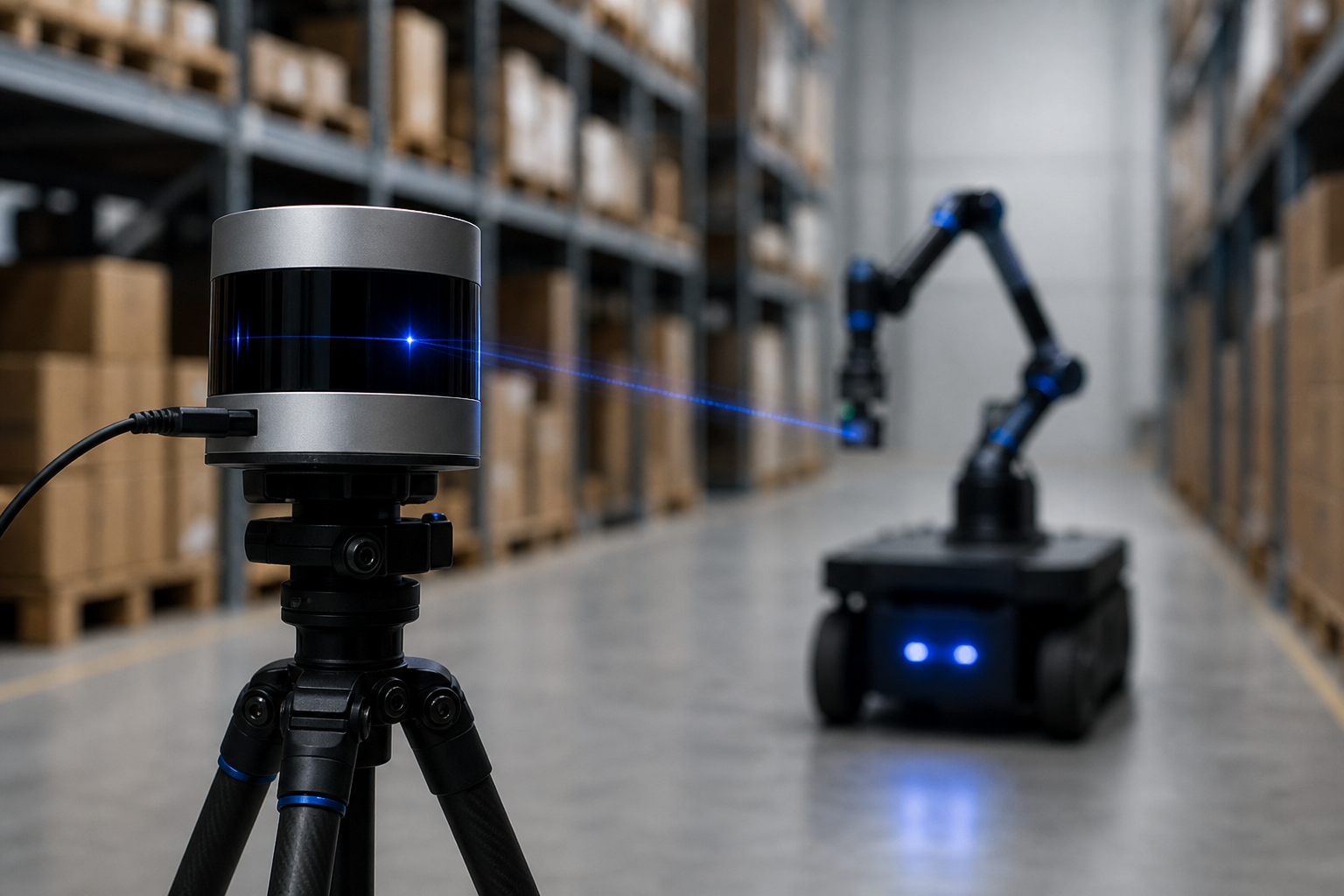
The modern real-to-sim pipeline has five stages. First, a LiDAR or photogrammetry scan of the deployment environment. Second, mesh generation and cleanup — decimation, hole-filling, semantic labeling of walls, floors, and dynamic objects. Third, physics calibration where friction, restitution, and joint damping are tuned against real measurements rather than copied from a tutorial. Fourth, sensor model alignment so the simulated camera or LiDAR matches the real one's noise profile. Fifth, domain randomization layered on top to handle residual variation.

This is no longer a research exercise. It is a production pipeline that should be allocated several weeks of engineering time before serious policy fine-tuning begins. Teams that compress this stage to a few days because they are eager to "see the model run" are the teams that ship demos in month two and unship them in month four.
Even a well-calibrated simulator is not a substitute for production data when you can collect it. Vendor Covariant emphasizes that the growth trajectory of RFMs is accelerating because vendors now collect large, diverse datasets directly from production deployments, not lab or simulation settings (Covariant, vendor source). Read that claim with the appropriate filter — Covariant sells exactly this — but the underlying point is correct. Simulation accelerates the loop. Production data closes it. The strongest deployments use both: calibrated sim for fast iteration, real production logs for periodic retraining.
There is also a cost dimension worth flagging. Lambert notes that scaling to trillion-token datasets likely requires large teleoperation markets, echoing the autonomous-vehicle industry's reliance on human overseers, and that this human-in-the-loop cost must be weighed against the benefits (Interconnects AI). For a deploying team, the practical implication is to budget for some teleoperated trajectory collection during your fine-tuning phase, even if your foundation model is excellent on paper. Plan for roughly one to two weeks of teleoperation on your actual hardware, in your actual environment, to bootstrap the demonstrations your fine-tune will consume.
Real-to-sim pipelines are the operational chokepoint where most projects either accelerate or die. Platforms that bundle LiDAR scanning, automated mesh-to-sim conversion, cloud simulation training, and one-click deployment to edge hardware — Jetson Orin Nano on the low end, Jetson T4000, T5000, or AGX Orin on the industrial end — collapse what used to be a multi-team coordination problem into a single workflow. The cap-x and OpenBrain stack that powers OpenKinematics is one example of this consolidation pattern; there are others. The architectural point is the same regardless of vendor: treat environment capture as a first-class engineering deliverable with its own schedule, owner, and acceptance criteria.
Most teams obsess over which foundation model to pick. The teams that ship in 2026 obsess over environment capture quality.
Morphology-Specific Deployment Patterns
Foundation model readiness is not uniform across morphologies. Manipulators and quadrupeds are deployment-ready in 2026. Humanoids and mobile manipulators require more custom tuning, more careful integration, and more honest scoping conversations with stakeholders.
| Morphology | Foundation Model Readiness | Typical Fine-Tuning Trajectories | Representative Tasks | Primary Deployment Constraint |
|---|---|---|---|---|
| Manipulators (6–7 DoF arms) | High | ~100–200 expert trajectories | Grasping, assembly, pick-and-place | Gripper-object friction calibration |
| Quadrupeds | High | Tens to a few hundred per gait/terrain | Locomotion, navigation, terrain adaptation | Custom leg geometry adaptation |
| Humanoids | Medium | Higher counts; task-specific | Walking, manipulation, HRI | Balance and safety constraints |
| Mobile Manipulators | Medium | Decoupled per subsystem | Bin picking, shelf management, logistics | Arm-base policy coordination |
The trajectory ranges in this table are anchored in the broad-pretraining-plus-narrow-adaptation pattern Levine documents: broadly pretrained models can onboard new platforms with a "very small amount of data," which in practice means tens to a few hundred trajectories per new morphology rather than thousands.
Manipulators got there first for three reasons. Task definition is clearer — pick this object, place it there, with this orientation tolerance. Open-source training data is larger and more diverse than for any other morphology. Standardized end-effectors such as parallel-jaw grippers and suction cups look similar enough across platforms that cross-embodiment transfer actually works. The practical recipe is reliable: start with a vision-based grasping foundation model, fine-tune on roughly 100 to 200 expert trajectories collected in your environment, and deploy. Teams using Franka Panda, UR5e, and UR10e arms are the clearest beneficiaries.
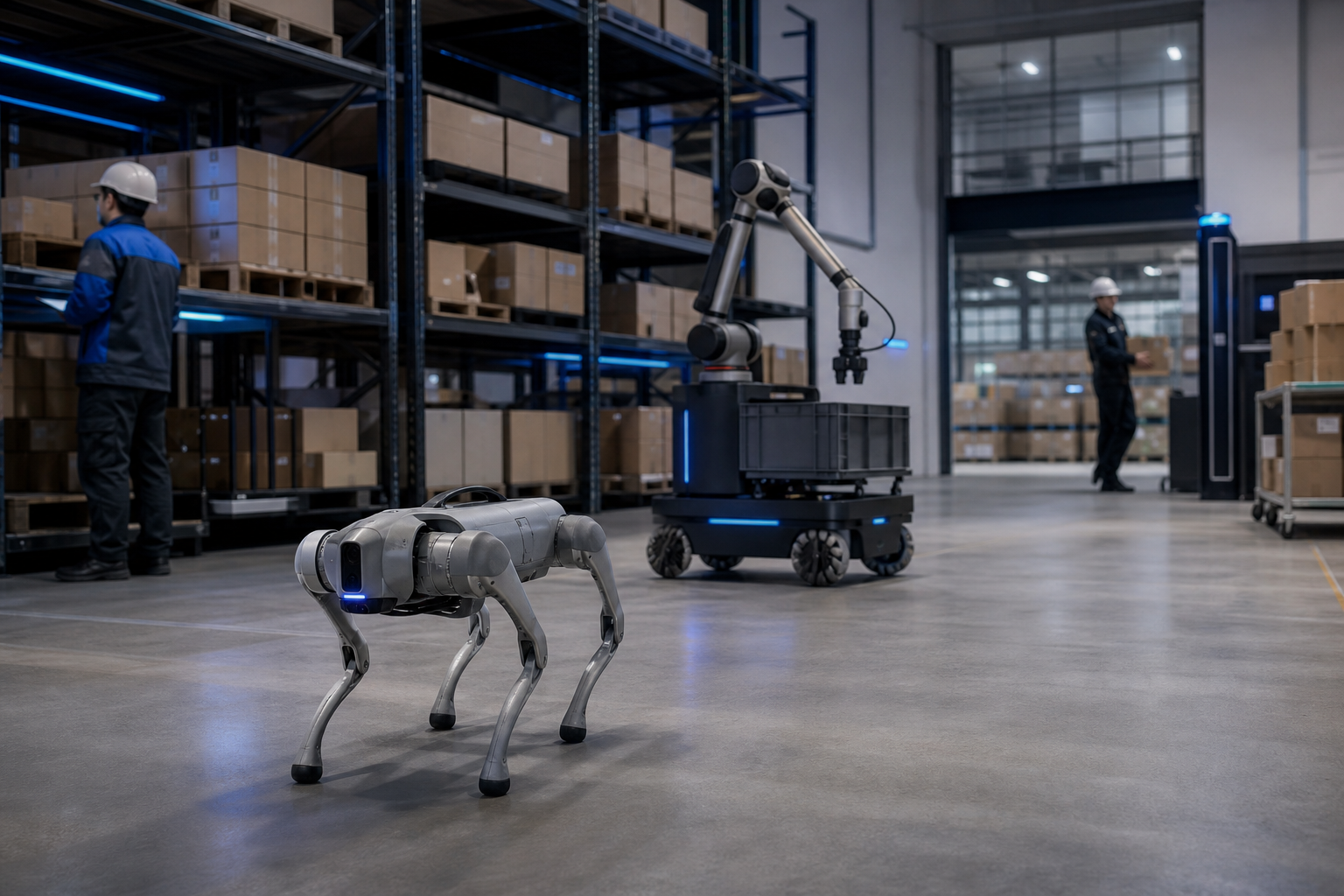
Quadrupeds are in a renaissance driven by foundation models combined with morphology diversity. Unitree-class platforms in particular benefit from pretrained gait priors — your fine-tuning loop targets terrain adaptation and task-specific gait selection, not learning to walk from scratch. A quadruped fleet running warehouse patrols, inspection routes, or outdoor logistics tasks is now deployable in roughly the same timeframe as a manipulator pilot, which was not true even eighteen months ago.
Humanoids remain the bottleneck. Balance and safety constraints still require custom tuning that foundation models do not yet solve. The arXiv 2026 survey explicitly flags open challenges in safety, robustness, dataset bias, and reproducibility as unresolved. For humanoids, the practical guidance is that foundation models accelerate upper-body manipulation skills meaningfully but cannot yet replace custom lower-body control. Treat them as a hybrid system: pretrained policy for the arms and hands, custom controller for balance and locomotion, careful integration layer between them.
Mobile manipulator pattern is now standardized. Decouple arm and base policies. Use a foundation model for the manipulation subtask, where the pretraining payoff is largest. Use a custom planner or smaller learned policy for base motion, where classical SLAM and motion planning still outperform end-to-end approaches in most warehouse and logistics environments. Fine-tune the coordination layer jointly on a small dataset of full-task trajectories — typically a few hundred — to teach the system when to drive versus when to grasp. This hybrid is the dominant warehouse pattern for a reason: it concentrates the foundation model where it adds value and uses proven classical methods where they remain superior.
A team capability note. If you have fewer than two engineers with PyTorch and ROS2 experience, hiring an integrator or using a managed deployment platform is the better leverage point — DIY fine-tuning will absorb more engineering time than the savings justify. If you have dedicated ML staff, in-house fine-tuning becomes economical above roughly five robots deployed, where amortization across the fleet justifies the integration overhead. Below that fleet size, the math typically favors managed deployment regardless of team composition.
Foundation models solved the question of what the robot should learn. The remaining bottleneck is whether your simulator matches reality and whether your morphology fits the pretraining distribution.
Your Foundation Model Adoption Checklist
This is the actionable ending. Print it, walk it into your next planning meeting, and run it as four phases over a single quarter. The goal is a deployed pilot inside twelve weeks with a clear go/no-go decision at the end.
Phase 1 — Pre-Selection
Before you talk to any vendor, get four things on paper.
- Define the task at deployment granularity. Not "make the arm smart." Write: "grasp novel SKUs from a 1.2 m-wide tote under variable warehouse LED lighting, cycle time under 4 seconds, success rate above 95% across 500 consecutive picks." Specificity here drives every subsequent decision.
- Document hardware constraints in writing. Robot platform and end-effector. Available edge compute — Jetson Orin Nano, T4000, T5000, or AGX Orin. Safety category required by your regulatory environment. Control frequency target. Network topology between robot, edge, and cloud.
- Audit your data pipeline. Can your team capture 100 to 200 expert trajectories in two weeks? If not, fix this before evaluating any model. The broad-pretraining-plus-narrow-adaptation pattern depends on your ability to produce the narrow adaptation data (Levine).
- Inspect your simulator honestly. Is the geometry from real LiDAR or guessed CAD? Is friction calibrated against measurements or copy-pasted from a tutorial? Are sensor noise models tuned to your actual cameras and LiDAR? Both the academic survey and NAIRL overview name sim fidelity as decisive.
Phase 2 — Vendor Evaluation
- Request specifics for all six evaluation criteria from the framework above — dataset scale and diversity, VLA architecture, tokenized actions, sim-to-real metrics on real hardware, deployment footprint, fine-tuning data requirements and licensing.
- Demand real-hardware results, not just sim benchmarks. Vendor and academic sources agree pure-sim numbers do not predict deployment performance. If a vendor only has Isaac Sim screenshots, they have a research prototype.
- Measure inference latency on your actual edge hardware, not on a cloud GPU. If the vendor cannot provide a Jetson-class benchmark or arrange a hands-on test, treat as research-grade.
- Verify license and commercial-use terms before committing engineering time. Confirm fleet-scale deployment is permitted, retraining rights are clear, and any required attribution or royalty terms are acceptable to your legal team.
Phase 3 — Pilot Deployment
- Allocate four to six weeks for real-to-sim environment setup. Not one week. This is the leverage point — compressing this stage is the most common cause of pilot failure.
- Collect 100 to 200 expert trajectories under controlled conditions matching your deployment environment. Use teleoperation, kinesthetic teaching, or scripted policies as appropriate. Log everything at full control frequency.
- Run an A/B test. Foundation model plus fine-tuning versus your current baseline — whether that is a classical controller, a vendor-supplied policy, or an existing in-house RL system. Use identical hardware, identical environment, identical task definitions.
- Measure two metrics. Time-to-first-working-policy from kickoff. Deployment success rate over at least 500 trials. The first metric is about whether the foundation model approach is faster. The second is about whether it is good enough.
Phase 4 — Go/No-Go Decision
- Is time-to-deployment under 12 weeks? If yes, the foundation model is worth the integration cost. If no, identify whether the blocker was the model, the environment capture, or the trajectory pipeline — and fix that specific stage before retrying.
- Did the sim-to-real gap close? If no, environment capture is the blocker, not the model. Reinvest in simulator fidelity before changing models.
- Can your team sustain the deployment without quarterly retraining? If no, you need a vendor with retraining-as-a-service, an open-source stack you can maintain in-house, or a managed deployment partner who handles ongoing model lifecycle.
A foundation model is a leverage tool. The teams that win in 2026 are the ones who treat environment capture, trajectory collection, and edge deployment as first-class engineering problems — not afterthoughts to the choice of which checkpoint to download.